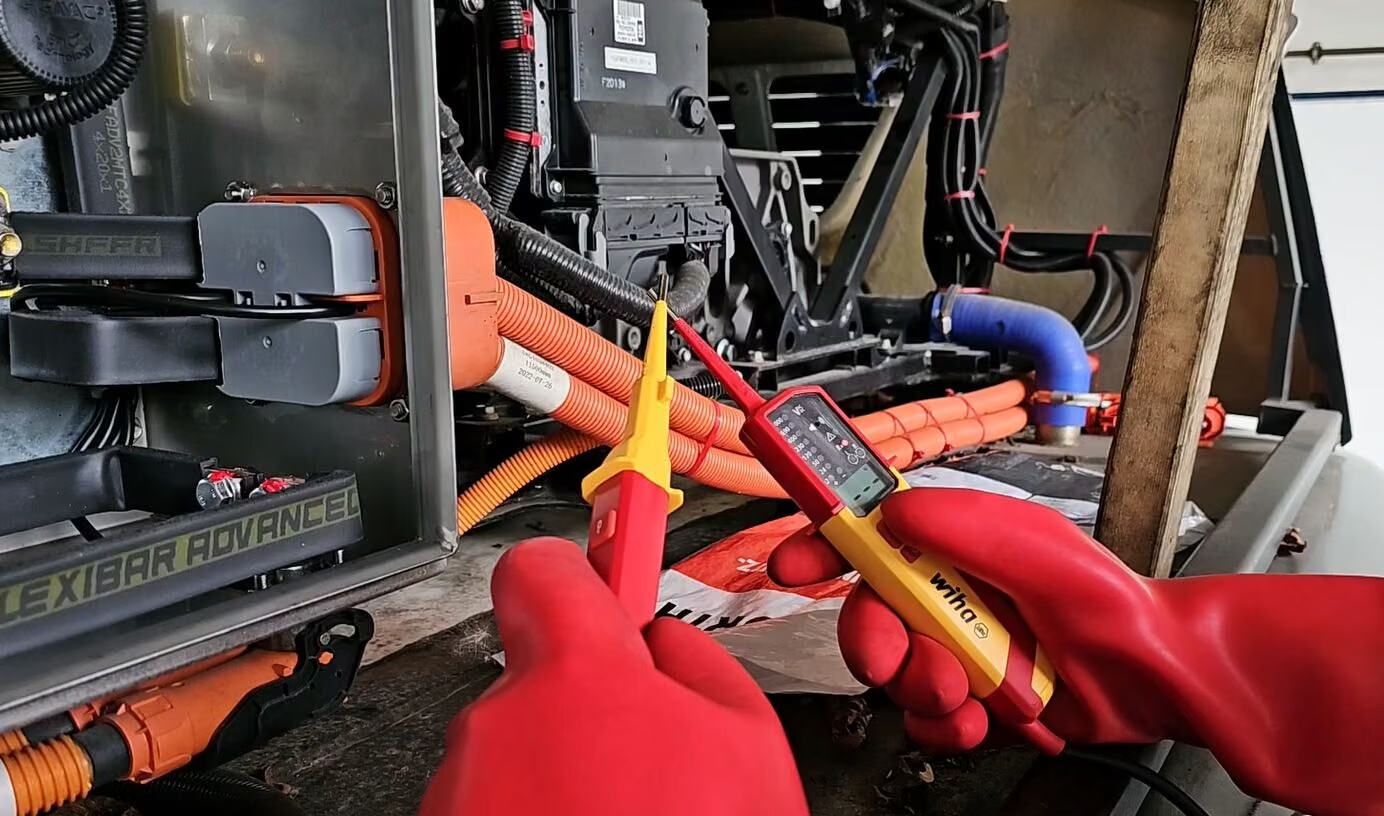
If the team lacks the necessary qualifications, the only option is to refer the customer to another garage. This does not involve any work on the high-voltage system or any live wiring. Even manoeuvring the vehicle into the workshop requires Level S training. Mirror replacement and paint touch-ups are classified as bodywork, and for this, the DGUV Information 209-093 Level 1S.
DGUV 209-093 draws clear distinctions between operation, general maintenance work and work on the high-voltage system. Here’s how to allocate tasks in your electric lorry workshop in line with staff qualifications and prepare the necessary training.
Qualifications by occupation
DGUV Information 209-093 sets out the qualification requirements for work on vehicles with high-voltage systems. For production vehicles, a distinction is made between levels S, 1S, 2S and 3S. The decisive factors are the work to be carried out and the associated electrical hazards.
A Level S-trained person is someone who has received training on the specific characteristics of a high-voltage vehicle. They are authorised to operate the vehicle in accordance with its intended use. This also includes activities involving a comparable electrical hazard, such as charging or cleaning. The training must be appropriate to the intended tasks and the vehicle in question.
The required level therefore depends on the actual task to be carried out. Anyone taking charge of the vehicle and driving it to the parking bay requires Level S. Anyone subsequently changing the tyres needs the qualification for general work under Level 1S. Define this division of tasks whilst preparing for Electric lorries in everyday workshop operations.
Year S in everyday school life
Receipt, Manoeuvring and Vehicle Maintenance
Level S is aimed at employees who operate electric lorries or carry out similar tasks. This includes drivers, service reception staff, yard staff and vehicle maintenance staff. The employer or a suitable person – for example, someone who has received specialist training – may be responsible for providing this awareness training.
When manoeuvring, employees must be familiar with the vehicle-specific controls and indicators. For loading, they require training on the designated loading equipment. In addition, there are guidelines on hazards relating to accidents, damage, recovery and towing. They must also be familiar with any additional controls, such as an emergency stop switch.
Level S also covers simple tasks involving a comparable level of electrical hazard. Examples include changing wiper blades, topping up the windscreen washer fluid and using familiar filling points. This does not constitute a general authorisation to carry out maintenance work on electric lorries.
The manufacturer’s specifications apply to the interior cleaning of the lorry and to exterior washing. All service hatches must remain closed during cleaning. High water pressure can damage high-voltage components. You should therefore consult the vehicle maintenance department to find out which cleaning methods are permitted for the vehicle in question.
Level 1S at the service centre
General work involving boundaries
A person who has received specialist training (FuP for short) is authorised to carry out general work on the vehicle. This work must not directly involve the high-voltage system. Typical examples include changing tyres, bodywork such as replacing a wing mirror, and work on conventional brakes, steering and axles. This also includes work on the conventional vehicle electrical system up to 30 volts AC or 60 volts DC.
The training must be delivered by a high-voltage specialist (FHV for short). It must last for at least two teaching units. The content includes electrical hazards, protective measures, and the location and labelling of high-voltage components. Prohibited work and how to act in cases of uncertainty must also be covered.
For service technicians, this distinction is crucial when carrying out work on high-voltage vehicles. A brake repair job may involve work in the vicinity of high-voltage components, for example when working on wheel hub motors. Before carrying out any welding, drilling or grinding work, the location of any components at risk must be known.
Air-conditioning servicing also requires an assessment of the specific scope of work. Work on an electrically powered high-voltage compressor falls outside the scope of the general authorisation granted under Level 1S. If the classification is unclear, staff must stop work and inform the relevant FHV. They must also report any damaged, kinked or crushed high-voltage cables.
Limitations of 2S and 3S
Working on a de-energised system
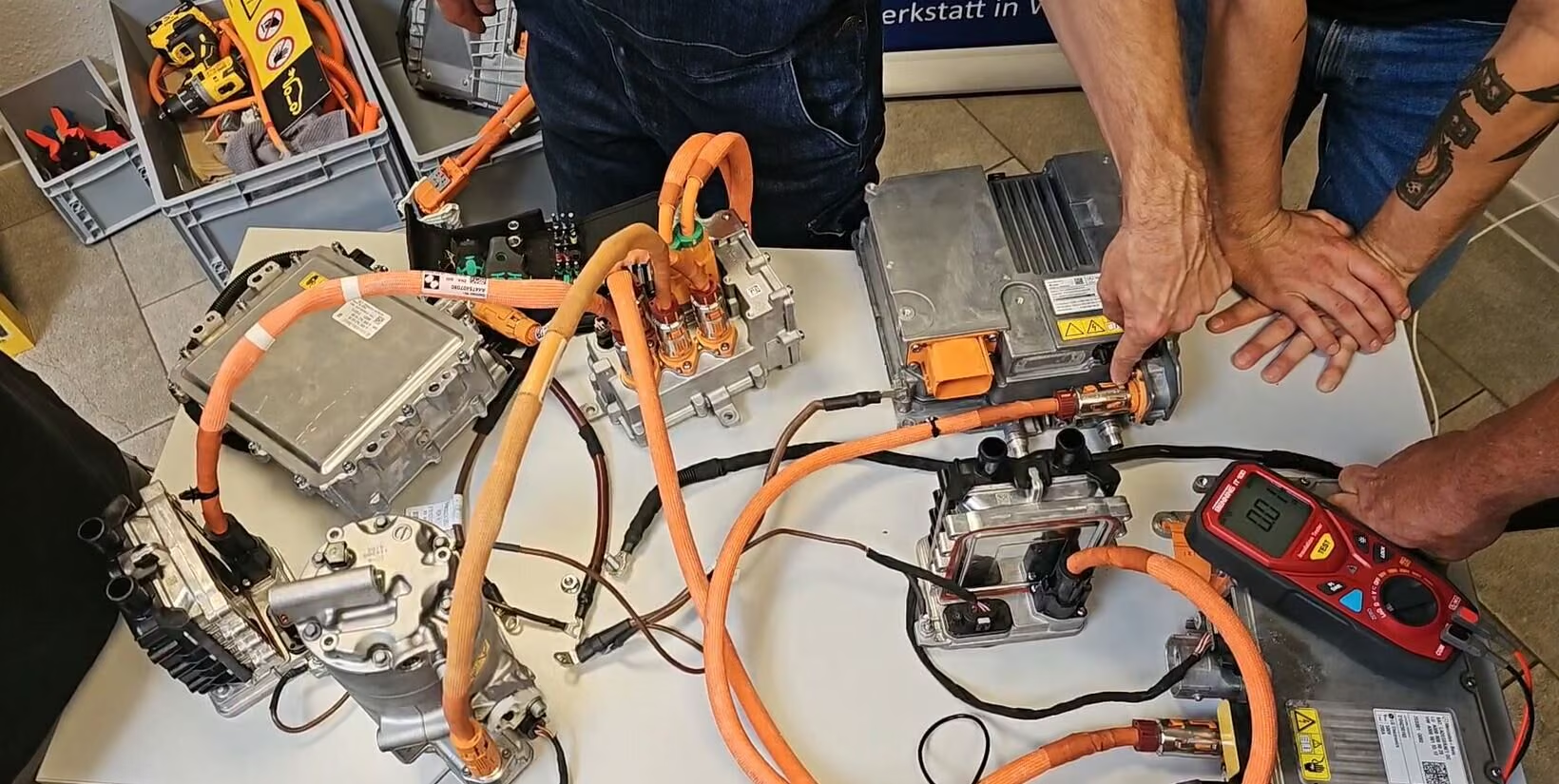
Level 2S covers work on the high-voltage system whilst it is de-energised. This includes repair, replacement, modification and testing, as well as insulation resistance measurements. Such work is carried out by a qualified electrician or under their supervision and direction.
The FHV must be able to ensure that the vehicle is de-energised in accordance with the five safety rules and the manufacturer’s instructions. Please bear this requirement in mind when planning repairs and diagnostics. The fact that the vehicle is switched off does not in itself prove that the high-voltage system is de-energised.
Training certificate: Anyone who has completed the motor vehicle mechatronics apprenticeship with a specialisation in commercial vehicle technology in accordance with the Apprenticeship Regulations of 14 June 2013 holds Level 2S professional competence.
You should therefore check any existing training certificates before deciding on further qualifications. When it comes to training in the commercial vehicle sector, you must take into account both the level of training and the permitted duties of each trainee.
Working on live circuits
Level 3S qualifies the holder to carry out work on live high-voltage components. This may include fault-finding and the replacement of live components. Levels S and 1S do not authorise such work. Nor does a Level 2S qualification automatically cover this work.
Training and certification
Repetition during operation
According to DGUV Regulation 1, Section 4 Training must be provided and documented at least once a year. If necessary, it must be repeated sooner. Section 12 of the Occupational Safety and Health Act (ArbSchG) It also requires training to be provided before work commences upon recruitment, when changing roles, or when new equipment or technologies are introduced. This also applies to new employees and trainees before they undertake their first relevant assignment.
Make a record of the date, participants, trainer, content and scope of activities covered. Keep evidence of qualifications and training records in a way that makes them easy to find. In the job planning, you can then see at a glance who is authorised to carry out which tasks.
You can check the current situation in the business using four key questions:
- Have reception staff and farm staff received documented training in accordance with Level S for their duties?
- Are staff qualified to carry out tyre changes and general servicing in accordance with Level 1S?
- Was the last training session less than twelve months ago?
- Are new employees and trainees given training before their first assignment driving an electric lorry?
Following an accident at work, the employers’ liability insurance association enquires about the training provided and the documentation relating to it. If the accident was caused intentionally or through gross negligence, those responsible are liable under SGB VII, Section 110 to the social security authorities for the costs incurred.
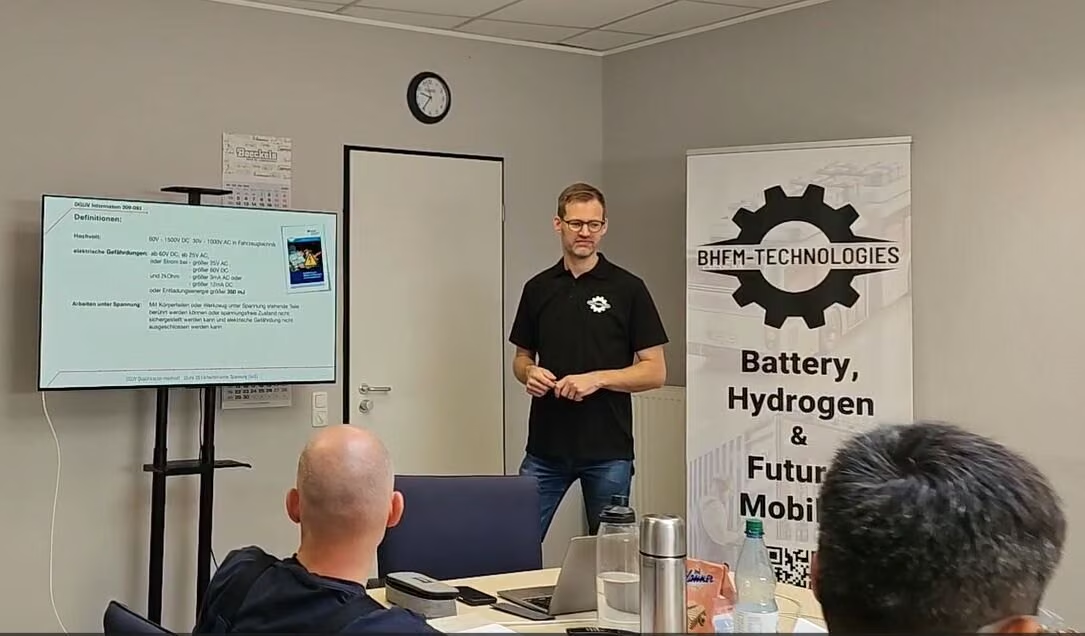
Within the Alltrucks training programme, BHFM is our partner for the high-voltage levels S to 3S. For acceptance and servicing, BHFM offers the combined S + 1S training course: a single session covering both levels, with up to 15 participants at level S and up to five at level 1S. Each participant takes a comprehension test and receives a certificate. With a fixed date each year, the annual refresher course is also organised.
Our partnership with BHFM includes practical training on real commercial vehicles using original components. The training takes place at the Boeckels workshop in Willich, an Alltrucks partner company. Integrate Alltrucks training courses into your company organisation: assign tasks, check certificates and set the next training date. You can book the training courses very easily via the Alltrucks training portal.