How independent commercial vehicle workshops and opening OE workshops diagnose across all brands on all common commercial vehicle manufacturers - from RMI rights to gateway passthrough and Alltrucks multi-brand diagnostics (KTS Truck V3) to ADAS calibration. Flanked by Alltrucks technical support.
The Alltrucks technical ecosystem bundles cross-brand truck diagnostics and technical support - for independent commercial vehicle workshops as well as for open OE workshops with a multi-brand strategy. Alltrucks partners use Alltrucks multi-brand diagnostics (Alltrucks KTS Truck V3 with Knorr-Bremse integration) for multi-brand operations. Alltrucks Technical Support offers comprehensive technical support in day-to-day workshop operations.
This guide summarises the most important findings from daily workshop practice in the Alltrucks partner network. It is also aimed at workshop managers, diagnosticians and owners of independent commercial vehicle workshops as well as OE workshops with a multi-brand strategy. It covers everything from the RMI-legally secured database to Alltrucks multi-brand diagnostics and structured troubleshooting on high-voltage systems.

In the past, an experienced mechanic narrowed down faults with his ears, hands and a multimeter. Today, on the other hand, highly networked control units, encrypted protocols and state-of-the-art software take centre stage. For independent commercial vehicle workshops and open OE workshops, this means that a powerful, cross-brand diagnostic system is the basic technical prerequisite for working on modern trucks. Cross-brand tools bundle the coverage of numerous commercial vehicle brands in a single platform. In the Alltrucks partner workshop, this is the Alltrucks multi-brand diagnostics based on the Bosch KTS Truck V3. The Knorr-Bremse diagnostics solution is fully integrated into this as a Gründerhaus contribution. The result: no system interruptions, convenient operation. The entire Alltrucks diagnostics ecosystem is therefore based on this.
| Building block | Typical workshop starting position | Function in everyday life |
|---|---|---|
| Cross-brand basic system | A diagnostic device with broad commercial vehicle brand coverage | Basis for everyday repairs across several manufacturers |
| Parallel tool as redundancy | Second device for additional brands and reliability | Closes gaps in coverage, keeps operations stable |
| OEM portal access (pass-through) | Transactional access to the manufacturer's own diagnostic backends | for in-depth repairs, programming, safety-relevant processes |
| System diagnostics supplement | Additive for brake and air systems | Covers special processes in-house |
Modern cross-brand systems cover MAN, Mercedes-Benz, DAF, Scania, Volvo, Renault Trucks, IVECO, Ford Trucks and other European and Asian manufacturers. The decisive factor here is not brand coverage alone, but depth: reading and deleting fault codes is the basis - more relevant, however, are actuator tests, calibrations, parameterisations and software-based service releases. A standardised multi-brand platform is therefore the practical basis for mixed customer fleets with several commercial vehicle brands. For brand-specific special cases, on the other hand, OEM portal access remains the intended method.
For the Alltrucks partner company, Alltrucks multi-brand diagnostics is the tool for everyday multi-brand work. The OEM portal access, on the other hand, is the supplement for manufacturer-specific software updates, in-depth ECU parameterisation and safety-relevant functions under SERMI.
„A standardised tool stack simplifies everyday workshop life: one platform, one training course, one update path. The partner network supports the familiarisation process - from the technology forum to the hotline.“
- Experience from the Alltrucks partner network
Technical framework: Modern commercial vehicle diagnostic protocols are based on ISO 14229 (Unified Diagnostic Services, UDS) on. The diagnostic data structuring is also available via ISO 22901 (ODX - Open Diagnostic Data Exchange) is standardised. The following also applies to the EMC conformity of the diagnostic hardware used ECE R10 as a binding basis. The EU Regulation 2018/858 regulates access to repair and maintenance information (RMI), SERMI on the other hand, the conditions of access to safety-relevant systems. Within this legal framework, Alltruck's multi-brand diagnostics and OEM portal access thus form two complementary levels of daily workshop work.

For decades, access to the manufacturer's own diagnostic systems was the OEM authorised dealers' strongest argument against independent workshops. Those without a contract simply could not access the relevant control units for many repairs. However, EU Regulation 2018/858 has fundamentally changed this situation since September 2020. As a result, independent workshops now have a statutory right to access the same repair and maintenance information (RMI) that is also available to OEM workshops.
Customers' fleets are becoming increasingly mixed. Typically, several commercial vehicle brands are already operating in parallel in a medium-sized fleet. Alltruck's multi-brand diagnostics are intended as a strategic supplement to OEM access. For brand-specific special cases, direct OEM portal access remains the intended method; for daily multi-brand operation, on the other hand, multi-brand diagnostics provides the practical platform.
SERMI certification (Security-Related Repair and Maintenance Information) has been mandatory for security-relevant systems - immobiliser, key programming, anti-theft devices - since 2023. It includes an identity check, a reliability check and defined security standards. Accredited conformity assessment bodies carry out the certification in the respective member state and it is valid for three years. Without SERMI, however, safety-relevant parts of the order (key/immobiliser) remain structurally closed to a workshop.
„OEM access is initially a hurdle - registration, certification, hardware. The effort is part of a modern commercial vehicle workshop organisation: for safety-relevant and brand-specific processes, direct manufacturer access remains the intended route, in addition to multi-brand diagnostics for everyday use.“
- Experience from the Alltrucks partner network
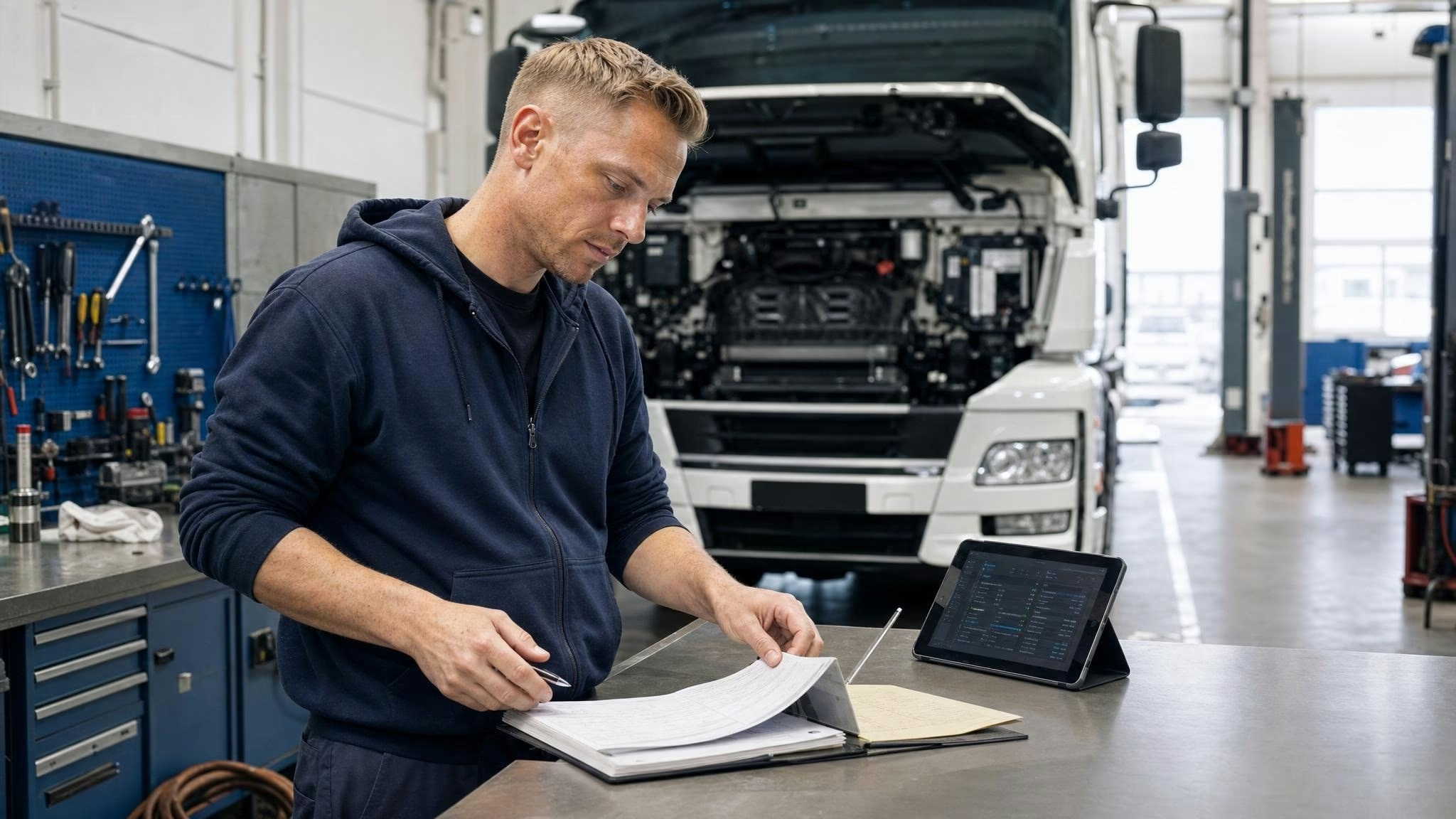
Practical Insight: The EU Regulation 2018/858 is not only a legal shield. It is also a negotiating tool vis-à-vis OEMs. In everyday practice, some manufacturer portals refuse access even several years after the regulation came into force or charge disproportionately high fees. In such cases, it is therefore worth escalating via the independent workshop association or directly with the responsible national type approval authority. Experience from the Alltrucks network shows: Documented escalations with reference to the RMI regulation usually lead to a rectification by the OEM. At the same time, workshops should also log their RMI portal accesses in an audit-proof manner (date, vehicle VIN, diagnostic effort) in order to have evidence in the event of a dispute about the invoice amount or data delivery. In addition to the type approval authority, accredited testing organisations are also points of contact for workshops.
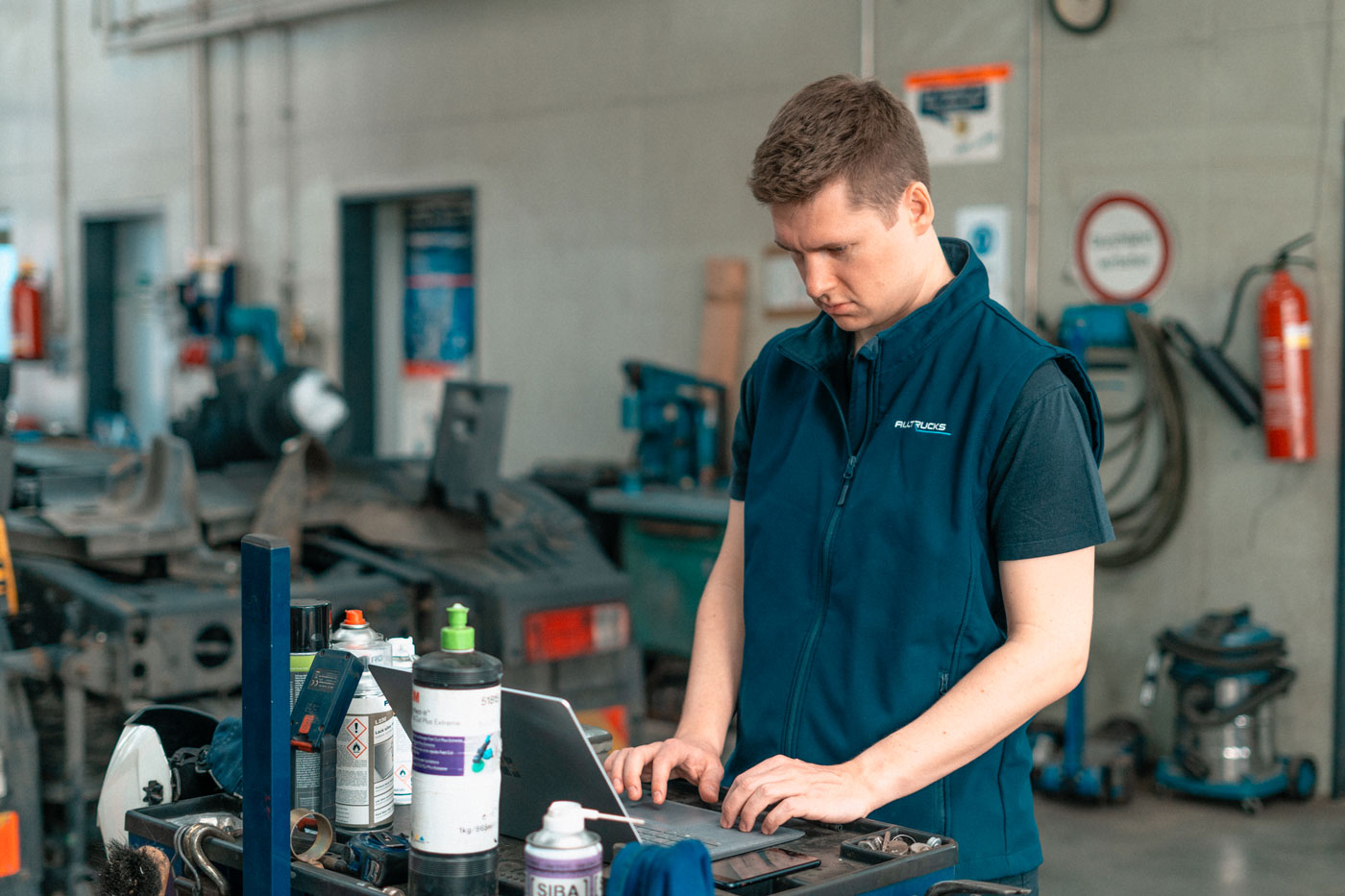
The Alltrucks multi-brand diagnostics is the tool that partner workshops use to efficiently service mixed fleets. Regular software releases continuously expand the vehicle coverage (including new e-truck models). They also provide updates for high-voltage diagnostic modules as well as up-to-date ADAS calibration guidance and extended software update functions via pass-through.
Not yet an Alltrucks partner? Six technical support components assist you in your day-to-day workshop work: the Alltrucks technology hotline for vehicle and system-specific queries, the Alltrucks Help Desk for structured ticket processing, Tips and tricks as a curated practical knowledge base, On-site support for setting up diagnostics in your workshop, Remote Support for the guided live support with diagnostic problems and the Alltrucks Technology Forum for the exchange of experience in the network - live at forum-alltrucks.com.
The systematic, guided evaluation of existing diagnostic data is also helpful in everyday workshop work. An example: A tractor unit shows P0299 (boost pressure too low) and P0401 (EGR flow rate too low). An experienced diagnostician recognises the pattern of a defective vacuum line that affects both systems simultaneously. Guided diagnostic workflows in modern diagnostic platforms support this pattern recognition via circuit diagrams, test instructions and live values. This is a noticeable relief for less experienced mechanics, especially in the case of complex multiple fault patterns.
ADAS calibration in the current diagnostic software is structured as a guided process. The guided calibration leads the mechanic step by step through vehicle positioning, target board alignment and verification. Front camera (in increasing model width), 77 GHz front radar, side radar for MAN, DAF and Volvo as well as lidar sensors in the commercial vehicle sector are also supported. Each calibration is also automatically logged with the date, time, vehicle data and result - a decisive advantage for liability safety.
„Cross-brand HV diagnostic modules standardise the toolbox for e-truck service: one platform across all supported manufacturers - embedded in the Alltrucks support ecosystem of training courses, technology forum and technology hotline.“
- Experience from the Alltrucks partner network
Practical framework: ADAS calibration is a separate discipline with clearly structured process management. In practice, a guided front camera calibration typically takes 60-90 minutes, while a complete radar calibration takes 90-120 minutes. The investment in ADAS targets, lidar tools and training is also one of the equipment items of a modern commercial vehicle diagnostics workshop; technically relevant factors include ISO 14229 (UDS) and ECE R10 (EMV). With Alltrucks partners, the Alltrucks training the development of ADAS and HV expertise through to certification as a multi-brand system technician; please contact us for individual qualification requirements.

More and more control units in modern commercial vehicles are protected by a security gateway - engine control, brake control, immobiliser. Without activation, there is therefore no write access, no calibration, no software update. However, access to the OEM backend is not tied to a single form of access. In addition to classic OEM contract access, independent garages can also use gateway pass-through technology as a session-based variant. This enables authenticated access to protected control units within the conditions specified by the RMI legal framework (EU 2018/858) and SERMI.
The multi-brand VCI serves as a „pass-through“ - hence the name Pass-Through. On the one hand, it connects to the vehicle via OBD, and on the other hand to the OEM backend via the Internet. The OEM server recognises the authenticated workshop, checks the SERMI certification and sends a time-limited activation token to the security gateway. The gateway then opens access for the duration of the session - typically 30 to 120 minutes. During this time, the workshop therefore has full access to all protected control units, including software updates and parameterisation.
Mercedes-Benz, DAF, IVECO and Ford Trucks support pass-through via the standardised J2534 interface. They also work with third-party VCIs such as the Bosch KTS series. MAN, Scania, Volvo Trucks and Renault Trucks, on the other hand, use proprietary protocols and require proprietary VCI hardware or portals. Pass-Through is transaction-based per access - a billing model per diagnostic session that offers a second form of subscription for authenticated ECU access in parallel to the classic OEM portal contract.
Gateway Passthrough is particularly suitable for workshops with broad brand coverage and a manageable volume per brand - in other words, for classic multi-brand operations. Conversely, high, brand-specific volumes tend to favour the full OEM annual licence. Which type of licence per brand suits the respective workshop profile is therefore a planning question based on the actual order structure, not general rules of thumb - let's go through the right constellation for your business together.
„Pass-through is a form of operation with its own infrastructure and process requirements. For Alltrucks partners, the technical hotline, help desk, tips and tricks, on-site support, remote support and the technical forum („Partner hilft Partner“, forum-alltrucks.com) coordinate practical day-to-day issues.“
- Experience from the Alltrucks partner network
Technical categorisation: Pass-through is technically elegant, but organisationally demanding. Another frequent source of errors in everyday life is an internet connection that is too slow or unstable - a cancelled software flash on the control unit can cause the affected control system to fail. A dedicated fibre optic line with mobile phone backup is therefore a good idea. The second common source of errors is non-certified or outdated VCI adapters. Commercially available multi-brand diagnostic platforms regularly update their VCI firmware. This is why a scheduled firmware check is part of every workshop routine and is documented in the diagnostic logbook.
Today, independent workshops cover the majority of everyday workshop tasks with a cross-brand diagnostic system - such as the Alltrucks multi-brand diagnostic system (Alltrucks KTS Truck V3). This includes reading and deleting fault codes, actuator tests, service releases and basic calibrations for common commercial vehicle brands. For manufacturer-specific software updates, in-depth ECU parameterisation and safety-related functions (key/immobiliser under SERMI), however, direct OEM portal access remains the intended method - either via a contract or session-based via pass-through. In this model, multi-brand diagnostics and the OEM portal are therefore additions, not alternatives.
The central basis is EU Regulation 2018/858 on the authorisation and market surveillance of motor vehicles. Since September 2020, it has obliged all manufacturers to grant independent workshops and diagnostic manufacturers the same access to repair and maintenance information (RMI) as their authorised networks. SERMI certification is also required for safety-relevant systems (immobiliser, key programming). In addition, the EU Block Exemption Regulation ensures that the manufacturer's warranty is not invalidated if maintenance work is carried out in an independent workshop.
The Alltrucks multi-brand diagnostics are based on the Bosch KTS Truck V3 interface. It also fully integrates the Knorr-Bremse diagnostic solution (Bosch + Knorr-Bremse as Alltrucks founders). MAN, Mercedes-Benz, DAF, Scania, Volvo, Renault Trucks, IVECO and other European and Asian manufacturers are covered. For safety-relevant systems, however, direct OEM portal access under SERMI conditions remains the intended route. Multi-brand diagnostics is therefore a strategic addition to daily multi-brand operations, not a replacement for OEM access. For details on KTS Truck V3 see <a href="https://help.boschdiagnostics.com/KTSTruck/#/home/QuickStart/de/default" target="_blank" rel="noopener external">help.boschdiagnostics.com/KTSTruck. Please contact us about suitability and introduction.
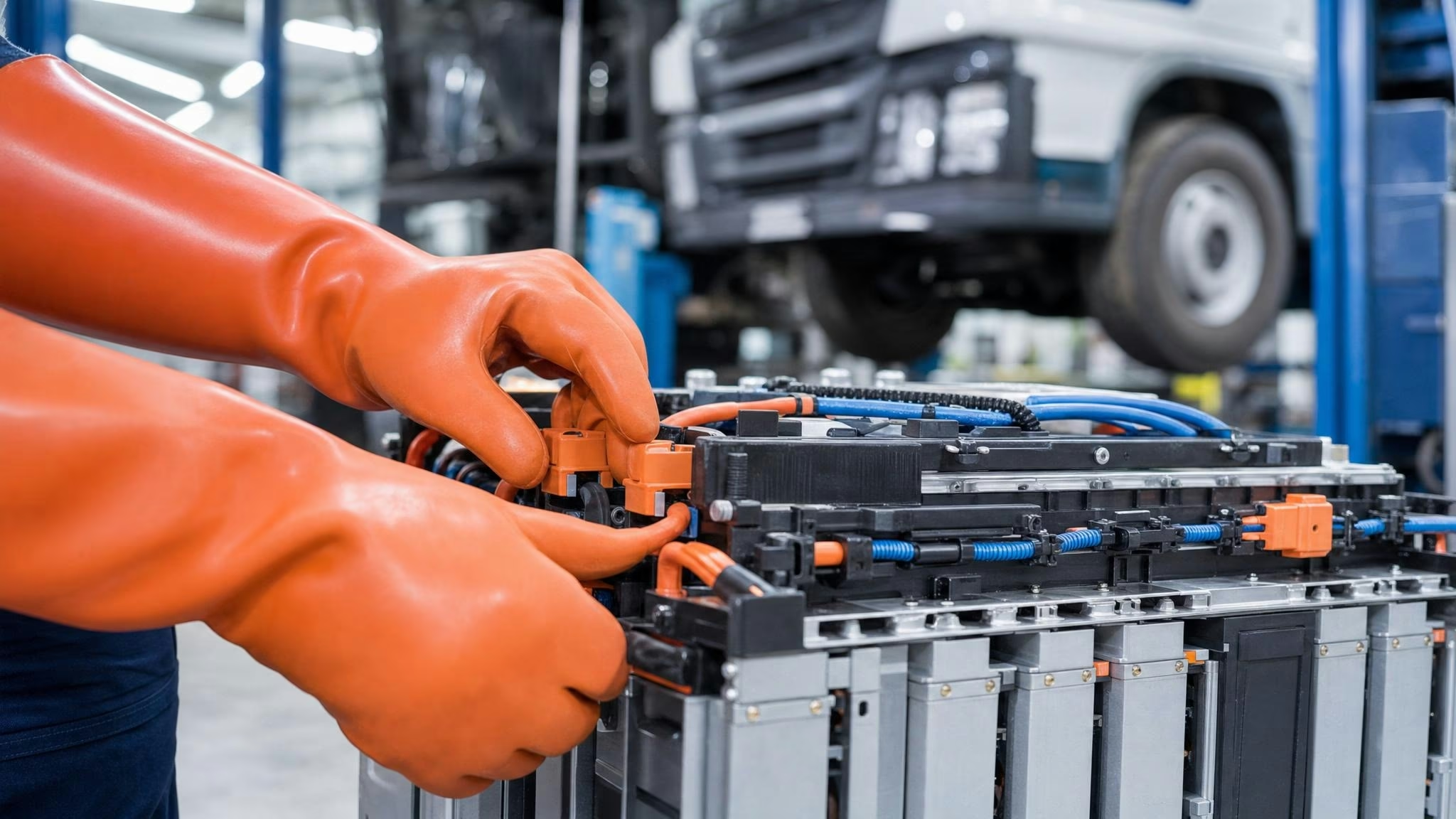
A qualification as a „qualified person for work on HV systems“ is required for diagnostics on high-voltage vehicles. It is based on the minimum requirements of EU Directive 2009/104, which has been transposed into national work equipment and operational safety regulations. The training covers the dangers of electric current, safety rules for HV systems and de-energised switching and measuring on HV components. A higher qualification level is also required for repairs to live parts. At Alltrucks partners, the <strong>Alltrucks training courses cover the qualification path up to certification as a multi-brand system technician; please contact us for a customised qualification path.