The electrification of the commercial vehicle sector is no longer a vision of the future - it is the present. An increasing number of series-produced electric lorries are coming onto the market. For independent workshops, this means that anyone who wants to work on electric vehicles must first fulfil the requirements - qualifications, equipment, safety area - before the first electric truck drives into the workshop. The requirements are clearly defined and the course can be set step by step. The qualification requirements for working on vehicles with high-voltage systems result from the EU Directive 2009/104 (Minimum health and safety requirements for the use of work equipment) and their national implementation. The status of „qualified person for electrical work on vehicles“ with the HV levels S, 1S, 2S and 3S is derived from this. In addition, high-voltage work in the electric lorry workshop requires insulated tools in accordance with IEC 60900 (hand tools for working on live parts up to 1000 V) is mandatory.
This article shows you which specific requirements your workshop must fulfil in order to be able to service e-trucks safely and economically. These include the qualifications of your staff, the necessary equipment, national subsidy programmes and entry-level support from Alltrucks - here you will find the specific roadmap for getting started. Already in the Order planning This is because it determines whether an e-truck runs efficiently through the workshop. In addition, diagnostic access via Gateway Pass Thru practically indispensable for electric vehicles. Depending on the country, the relevant national authorities publish market data and funding scenarios.
Our information on inspection obligations and occupational safety is based on EU Directive 2009 104 on minimum health and safety requirements for the use of work equipment and the respective nationally implemented regulations, such as the German Ordinance on Industrial Safety and Health. The specific risk assessment, the definition of inspection intervals and compliance with national legislation remain the responsibility of the respective workshop operator.
An electric truck workshop is a commercial vehicle service centre with high-voltage qualifications, special safety equipment and high-voltage tools. It also fulfils the requirements for a qualified person for electrical work (EU Directive 2009/104, transposed into national regulations). This enables them to maintain, diagnose and repair battery electric lorries, including the high-voltage components.
Why is the HV qualification the basic requirement?
Nobody is allowed to work on high-voltage components of an electric lorry without qualified personnel - this is not a recommendation, but applicable law. Based on EU Directive 2009/104 and its national implementation, there are therefore clear qualification levels for working on high-voltage systems. Levels S, 1S, 2S and 3S are particularly relevant for everyday workshop work. If you want to delve deeper, you can also find more information in the article on ADAS calibration Further information.
Level S: General electrician
The S training programme teaches employees how to handle high-voltage vehicles safely and as intended. The focus is not only on the special features of daily operation, but also on potential hazards in exceptional situations. Additional risks can arise in particular in the event of accidents, damage and when recovering or towing HV vehicles. The training sensitises participants to these particular challenges and provides them with the necessary knowledge to act safely and responsibly in critical situations.
Level 1S: Qualified instructed person for HV systems in commercial vehicles
Level 1S is the minimum qualification for any mechanic working on HV components. It also includes the safe disconnection of HV systems, the absence of voltage test and the use of personal protective equipment.
Qualified persons may carry out general work on the vehicle that does not directly affect the HV system.
This includes, for example, body work, oil and wheel changes, work on the conventional brake system in the vicinity of wheel hub motors, work next to the HV lines on the steering, combustion engine, axles, etc. as well as work on the conventional vehicle electrical system (up to 30 V AC and 60 V DC).
More extensive mechanical work, such as welding, drilling and grinding work, may also be carried out in the vicinity of HV components. This requires knowledge of the exact location of the HV components and instruction by a specialist.
Level 2S: Qualified person (FHV) for work on high-voltage systems in a de-energised state
Successful qualification at this level enables the experts to work independently and safely on high-voltage systems. All work on de-energised HV systems and components or in their hazardous area, e.g. measuring insulation resistance, repairing, replacing, modifying and testing are all part of work on high-voltage systems in a de-energised state.
The qualified person (qualified person) can establish the de-energised state in accordance with the safety regulations and the manufacturer's specifications. In addition, the FHV can instruct other persons on the dangers of high-voltage systems. The training typically lasts three to five days and concludes with a practical test. In the Alltrucks network, the Alltrucks 1S and 2S training courses cover precisely these HV qualifications.
UAS can instruct other persons on the dangers of high-voltage systems.
Level 3S: Qualified person for HV systems with extended authorisations
Level 3S qualifies you to work on live HV components and to assess complex fault situations. This qualification is therefore recommended for workshop managers and diagnostic specialists. The training builds on level 2S and comprises a further two to three days. For a workshop with four to six mechanics, at least one employee with level 3S is also recommended.
Alltrucks modules for HV beginners: Alltrucks training in HV levels 1 and 2S for partner workshops (cross-brand, not limited to one make) as well as certification as a multi-brand system technician. We will be happy to discuss which levels are suitable for which team set-up.
What workshop equipment does an e-truck service need?
| Component | Investment | Amortisation |
|---|---|---|
| HV Qualification Team | Training level 2S, 3 to 5 days per head | short term |
| Insulated HV tools | Complete VDE set according to IEC 60900 | Short to medium term |
| HV safety area | Closed-off work area in accordance with HV safety regulations | Medium-term |
| HV battery test bench | Insulation test, cell diagnosis, capacity test | Medium to longer term |
| ADAS calibration system | Targets for front camera, radar, lane departure warning system | Medium to longer term |
| Charging infrastructure workshop | AC wallbox 22 kW (entry level) to DC fast charger | longer term |
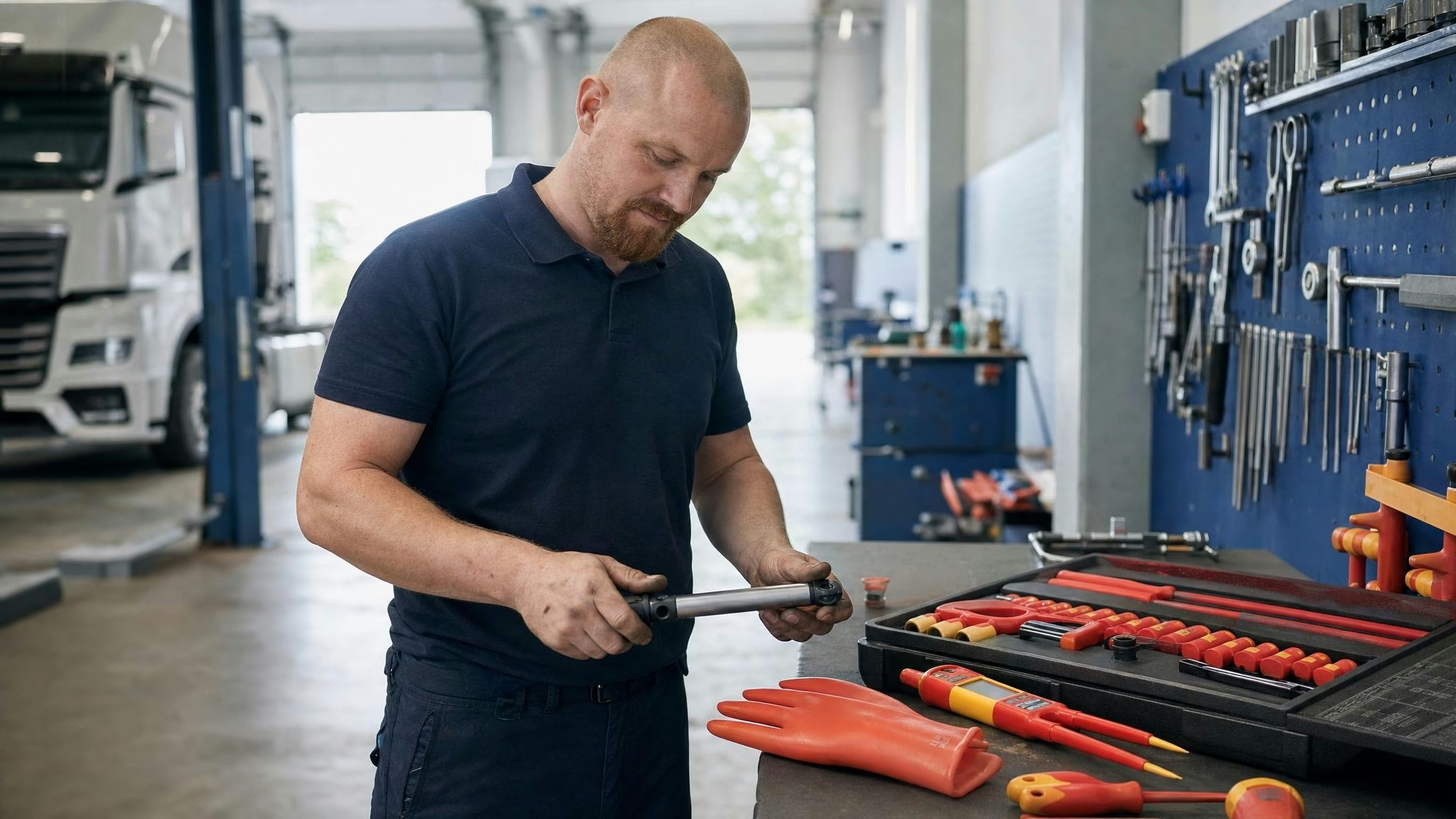
In addition to the qualification, you also need special tools and equipment that meet the safety requirements for working on high-voltage systems.
Insulated tool (VDE-certified)
Only VDE-certified tools in accordance with IEC 60900 are authorised for working on HV components. A complete HV tool set for commercial vehicles includes screwdrivers, pliers, ring spanners and open-end spanners, torque spanners and sockets - all insulated up to 1,000 V. You must also check the tools regularly for damage to the insulation. Replace damaged tools immediately.
Personal protective equipment (PPE)
PPE for HV work includes insulating gloves (class 0 or 00), face protection or safety goggles with side protection, flame-retardant work clothing and insulating shoes. You should also calculate a complete PPE set per employee. You must check the gloves for leaks before each use - a compressed air test is sufficient. The electrical test is then carried out every six months. Detailed information on the Safety rules for HV work can be found in the corresponding article.
Measurement technology
An insulation measuring device (CAT III/IV) is essential for the absence of voltage test and insulation resistance measurement. In addition, you also need a two-pole voltage tester in accordance with the applicable national regulations for electrical equipment to verify the absence of voltage. Single-pole testers or multimeters alone are not sufficient.
| Equipment | Procurement | Test interval | Remark |
|---|---|---|---|
| HV tool set (VDE) | Complete set according to IEC 60900 | Before each use (visual inspection) | IEC 60900 certified |
| PPE per employee | Complete set according to HV safety regulations | Gloves half-yearly electrical | Class 0 or 00 |
| Insulation measuring device | Professional device CAT III/IV | Annual calibration | CAT III/IV |
| Voltage tester (two-pole) | According to national test specifications for electrical equipment | Annual calibration | EU 2009/104 (national implementation) |
| Barriers & signposting | Complete equipment for one parking space | If required | HV safety area |
| Level 2S training (per employee) | 3 to 5 days external training | Refresher every 12 months | Alltrucks partner conditions |
How do you set up an HV safety zone correctly?
You must set up a defined safety area in the workshop for work on high-voltage vehicles. Clear minimum requirements therefore result from the specifications for the qualified person for electrical work (EU 2009/104, national implementation):
- Floor marking: Yellow and black markings (warning colours in accordance with ASR A1.3) around the workplace, at least 1.5 m away from the vehicle
- Access control: Only qualified personnel (from level 2S) may enter the HV area as long as work is being carried out on the HV system
- Signposting: Warning sign „High voltage - danger to life“ in accordance with DIN EN ISO 7010 (W012)
- Rescue equipment: CO2 fire extinguisher (at least 5 kg), first aid equipment incl. rescue hook and insulating rescue blanket
- Emergency plan: Emergency procedure posted with telephone numbers, rescue chain and contact persons
The safety area is set up once and includes floor markings, signage, barriers and rescue equipment. It is also mandatory before the first e-truck enters the workshop.
What charging infrastructure does the e-truck workshop need?
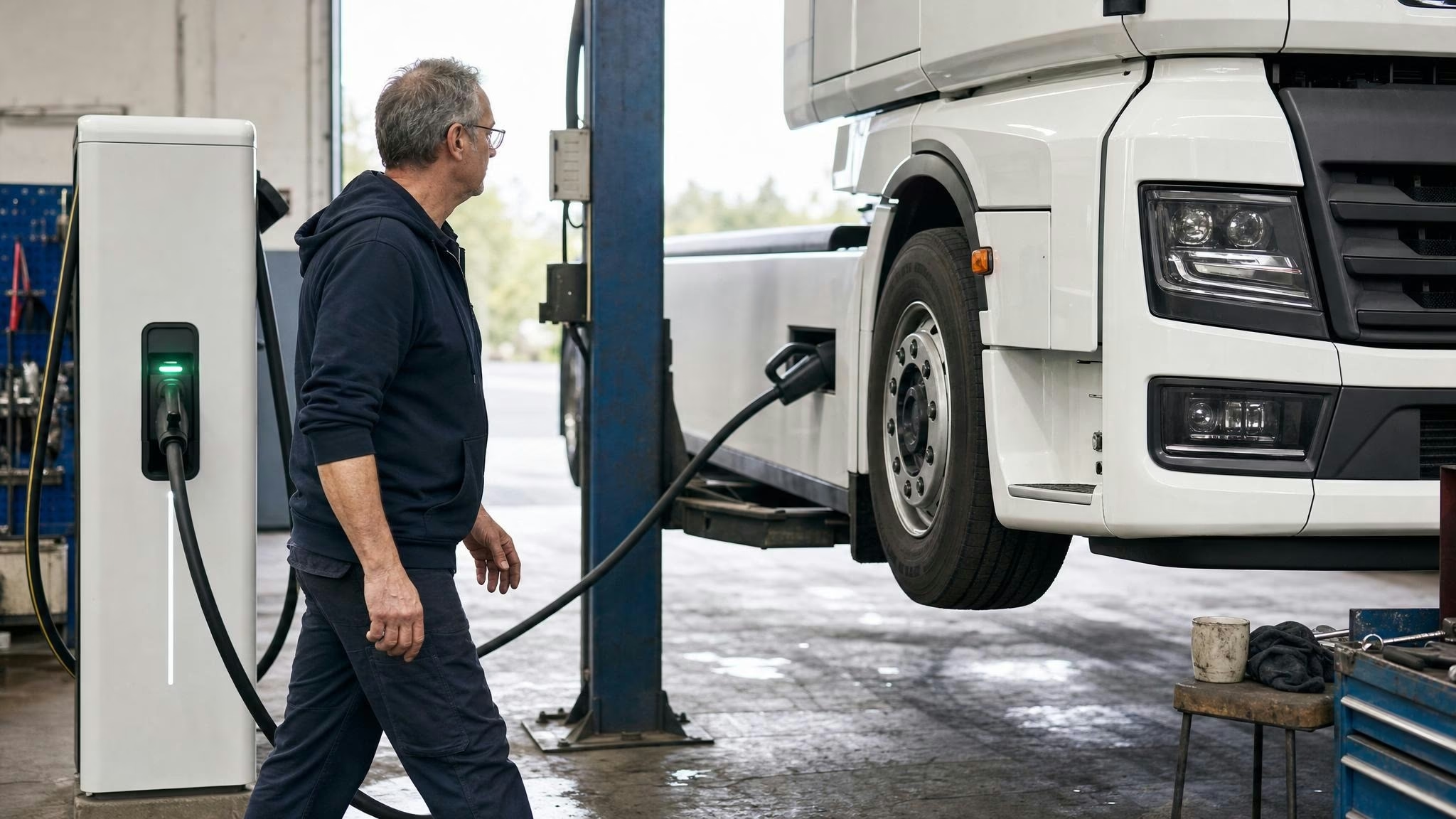
You must be able to charge e-trucks while they are in the workshop - at least to the point where they can leave the workshop under their own power. This therefore requires an appropriate charging infrastructure. There are two possible options for workshop operations:
AC charging (alternating current, 22-44 kW)
An AC wallbox or charging station with 22 kW is the simplest entry-level variant. The charging power is also sufficient for overnight charging during a workshop visit lasting several days. This is therefore sufficient for workshops that mainly receive e-trucks for maintenance work.
DC fast charging (50-150 kW)
A DC quick charging station enables charging within a few hours. The charging station and grid connection (transformer station, supply lines) are significantly higher than for an AC wallbox. This variant can be relevant for workshops with a high volume of e-trucks or short throughput times - but it is not necessary for entry-level users.
Tip: First check the existing mains connection of your workshop. Many existing buildings have a power connection that is sufficient for a 22 kW wallbox. Installation is also straightforward and can be completed within a day. You can also find information on overall investment planning in our article on e-mobility investment planning.
What service work is required on the traction battery?
The traction battery is the most valuable component of an electric truck. Typical service work therefore includes
- Status check (State of Health): Reading out the battery data via the vehicle diagnostics, evaluation of the remaining capacity and ageing condition
- Cooling system maintenance: Checking and filling the battery cooling circuit, cleaning the cooling fins, functional test of the coolant pump
- Module exchange: Depending on the vehicle architecture, it may be possible to replace modules instead of replacing the entire battery if individual modules are defective
- Insulation test: Regular measurement of the insulation resistance to protect against residual currents
HV work also requires higher qualifications (qualified person for electrical work, EU 2009/104) and an extended safety organisation - both of which are taken into account when calculating the cost. Hourly rates one. How you set your own HV hourly rate remains your own decision. For the technical part of the service work on mixed fleets, Alltrucks partner workshops can use the Alltrucks multi-brand diagnostics (Alltrucks KTS Truck V3, with Bosch and Knorr-Bremse integration) is available. For special cases within the e-truck service, the following is also SuperPanther Available as a specialist service partner within the Alltrucks network for hydrogen-powered lorries (H2) from 1 April 2026 REFIRE.
How does Alltrucks support the entry into e-truck maintenance?
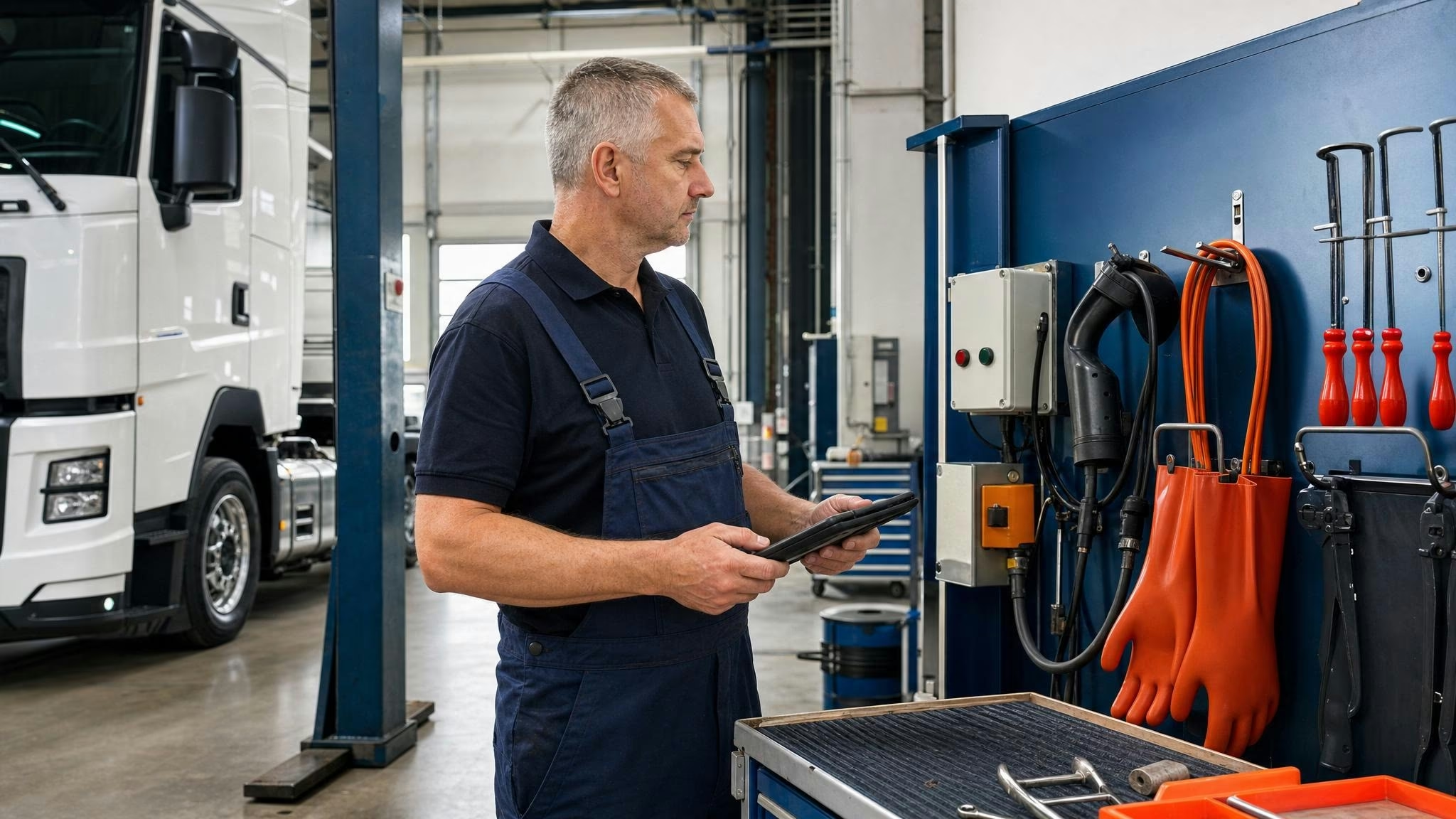
Specific modules are available in the Alltrucks network for Alltrucks partner workshops interested in the e-truck service. We will be happy to discuss which combination suits your business. For overall investment planning, see also the article on E-mobility investment planning.
Qualification
Alltrucks training HV level 1 and level 2S (qualified person for electrical work) - cross-brand, not limited to one make. This is supplemented by certification as a multi-brand system technician. We are happy to discuss conditions for partner workshops: please contact us.
Diagnosis & multi-brand
Alltrucks multi-brand diagnostics with the Alltrucks KTS Truck V3 (Bosch + Knorr-Bremse integration) as well as access to the Alltrucks technical hotline and Alltrucks technical forum („Partner helps partner"). SuperPanther is also involved as a service partner for specialised e-truck service cases, and REFIRE for H2 trucks since 01.04.2026.
Process & entry
Feel free to contact us to get started. We will clarify which Alltrucks modules are relevant for the respective company: Training, multi-brand diagnostics, partner conditions with WESP CV for workshop equipment and HYMER access technology.
„The entry into the e-truck service is not a single decision, but a chain of steps: qualification, tools, safety area, diagnostics. Those who approach this in a structured way end up taking fewer detours than those who retrofit selectively.“- Experience from the Alltrucks partner network
Which lifts are suitable for e-trucks?
Your existing Lifting platforms must be checked for e-trucks and retrofitted if necessary. Key requirements include insulated mounting points, ESD protection and a load capacity that takes into account the additional weight of the traction battery. This is because e-trucks typically weigh 1 to 2 tonnes more than their diesel counterparts. To remove the battery, you also need a lowering device or a battery table that can take loads of up to 3 tonnes.
ADAS calibration is another topic that is becoming increasingly important with electric trucks. This is because many electric commercial vehicles have advanced driver assistance systems that need to be recalibrated after work on the chassis, steering or windscreen. Specific calibration obligations and intervals always depend on the specifications of the respective vehicle manufacturer. Read our article on ADAS calibration.
- Inventory: How many e-trucks are there currently in your catchment area? Ask your fleet customers about their electrification plans
- Provide at least two mechanics for Alltrucks training HV level 2S - please contact us for partner conditions
- Procure HV tool kit (VDE-certified, IEC 60900) - Check partner conditions via WESP CV in the Alltrucks network
- Planning the HV safety area: floor markings, signage, rescue equipment
- Have lifting platforms tested for electric lorry suitability (load capacity, insulation, ESD)
- Install AC wallbox (22 kW) for basic charging during workshop visit
- Talk to us about how Alltruck's multi-brand diagnostics (KTS Truck V3), SuperPanther (e-truck service partner) and REFIRE (H2) fit in with your company profile
- Investment plan for the next 3 years create