Economic efficiency
Profitability of the commercial vehicle workshop: Hourly rate, contribution margin and cost control: which key figures make the margin visible.

The profitability of the commercial vehicle workshop is not a question of gut feeling. Rather, it is a combination of reliable key figures, costing and strategic management. However, the reality is often different: Many workshop owners know what they are realising. However, they do not know what actually remains as profit. This results in businesses that work well operationally but fall short of their economic potential.
| Cost item | Share | Optimisation approach |
|---|---|---|
| Personnel costs | 48 to 55 per cent | Productivity and capacity utilisation |
| Parts and material | 18 to 24 per cent | Framework agreements and identical parts |
| Room costs and energy | 9 to 12 per cent | LED and heating control |
| Depreciation of equipment | 7 to 10 per cent | Life cycle planning |
| IT and software | 3 to 5 per cent | Cloud consolidation |
A pattern from industry practice: The most profitable workshops are not necessarily the largest or those with the most orders. Rather, they are the ones who know their key figures, measure them regularly and derive decisions from them. Hourly rate levels and margins are therefore the result of systematic work on the right parameters.
Three key figures form the foundation of every economically sound commercial vehicle workshop. If you don't know them, you are steering blind. Those who know them, on the other hand, can intervene in a targeted manner - and often with surprisingly small adjustments.
„In the independent commercial vehicle workshop sector, a significant proportion of businesses do not calculate their hourly rates to cover costs. The most common mistakes: underestimating overheads, ignoring non-productive times, not passing on price increases.“
- Observation from the Alltrucks partner network
The break-even analysis answers the most important question of everyday workshop life: How many invoiced hours per month are your fixed costs covered? Anything above that is profit. In practice, this shows that a workshop with four mechanics and 22 working days per month typically requires around 5 to 6 billable hours per mechanic per day until the break-even point is reached. Every additional hour thereafter directly improves the margin.
The break-even analysis also shows how sensitively profitability reacts to changes: An hourly rate increase of a few per cent noticeably lowers the break-even - in the typical model by several dozen hours per month. An additional mechanic, on the other hand, increases the billable hours, but also the fixed costs. Anyone who plays through this starting point understands the economic mechanics of their own business.
Many workshop owners equate increasing turnover with acquiring new customers. There are three approaches that are at least as effective and cost significantly less: increase productivity (every additional billable hour per mechanic per day increases the monthly turnover by a full hourly rate times 22 working days - per mechanic), noticeably increase the average order value through systematic upselling and calculate the parts margin in a differentiated manner (significantly higher mark-ups can be applied to specialised components than to standard parts).
Practical Insight: In the industry, the most important differentiator between profitable and unprofitable companies is rarely the hourly rate. Rather, it is the realisation of the hourly rate: how much of the work performed is actually invoiced. In terms of methodology, full cost accounting and hourly rate calculation are also based on the principles of VDI 2895 (Organisation of maintenance) on. Their life cycle cost analysis in turn adopts the definitions from DIN EN 13306 (maintenance terms). The most important adjusting screw is therefore the daily timesheet review by the workshop manager - a practice that is not yet consistently practised in many independent commercial vehicle workshops according to industry observations from motor vehicle trade associations.

The hourly rate is the central adjusting screw for the profitability of every commercial vehicle workshop. Nevertheless, in most companies it is not based on a solid calculation. Instead, it is based on what the competition charges, what the tax consultant has recommended or - even more frequently - on what has „always been the case“. The result: a significant proportion of commercial vehicle workshops work below their minimum hourly rate. In a typical case, this shortfall is well below the cost-covering rate. With around 1,500 invoiced hours per mechanic per year, this adds up to a substantial annual profit that goes unnoticed.
The following method is applicable to commercial vehicle workshops of any size. Firstly, take an afternoon to analyse your BWA and cost statements:
„Ultimately, the hourly rate level is a function of three factors: reliable full cost accounting, clear competence signals on the market (certifications, brand coverage, documentation) and consistent price communication. Those who systematically build up the three building blocks argue their price from their own cost structure - not from a comparison with the competition.“
- Practical observations from the Alltrucks partner network
A solid calculation is useless if the price cannot be realised. Therefore, three proven drivers help: Communicating value instead of defending price (Multi-brand expertise with the Alltrucks Multi-brand diagnosis / Alltrucks KTS Truck V3, certification as a multi-brand system technician via Alltrucks training level 1/2/3, warranty, digital documentation), Use network affiliation as a competence signal (workshop finder, Alltrucks marketing tools) and Communicate price increases professionally (at least 4 weeks in advance, objective justification, emphasise countervalue). With moderate, objectively justified hourly rate increases, experience has shown that the loss of customers is minimal. This is because the margin gained usually more than compensates for it.
Practical Insight: The hourly rate calculation must separate two components: the productive hourly rate (mechanic labour costs + social security contributions + workplace costs) and the administrative hourly rate (management, accounting, marketing, insurance). The proportion of administrative overheads is also considerable in the commercial vehicle workshop industry. Anyone who does not take this into account is therefore structurally working below full costs. Established calculation guidelines for commercial vehicle workshops therefore recommend a three-pillar structure: basic wage value + workshop overheads (rent, energy, tools) + administrative overheads + risk costs + entrepreneurial profit. Those who calculate on a full-cost basis raise their hourly rate level recognisably above the industry average. Those who remain below this level, on the other hand, are cross-financing their customers.
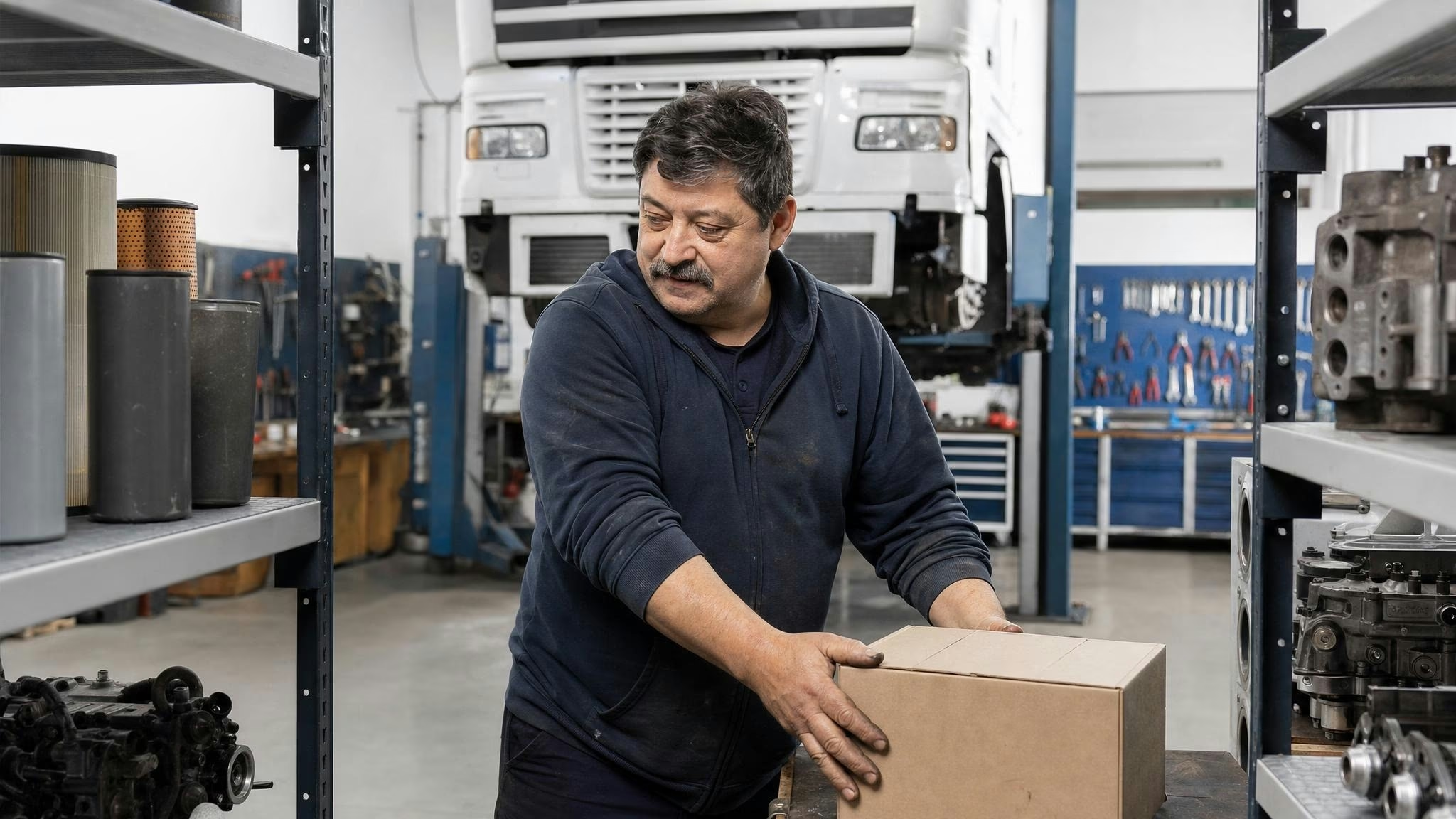
Cutting costs sounds like sacrifice and loss of quality. In reality, however, the opposite is true: those who know their cost structure and optimise it in a targeted manner create financial scope for better equipment, higher wages and investments. In most commercial vehicle workshops, there is therefore potential for savings of 15 to 20 per cent - not by cutting costs, but by eliminating waste, renegotiating overpriced contracts and optimising processes.
| Degree of specialisation | Typical adjusting screw | Indicative return on sales |
|---|---|---|
| Universal basic services | Utilisation, processes, acceptance quality | 8 to 12 per cent |
| Multi-brand system expertise | Diagnostic penetration, full cost calculation | 10 to 15 per cent |
| High-voltage E-truck service | HV qualification, investment protection | 12 to 18 per cent |
| ADAS calibration | Certification, calibration environment, brand coverage | 12 to 18 per cent |
Rule of thumb for the cost structure of a commercial vehicle workshop: 50-60 % is accounted for by personnel, 20-30 % by materials and parts, 10-15 % by space costs and energy, 5-10 % by administration and miscellaneous. Experience has shown that the greatest savings potential lies in not in the largest cost block (personnel), but in materials and energy - because this is where optimisation takes place least often.
Not every saving requires money. Here are three immediate measures that cost nothing and take effect immediately: Check insurance policies for overlaps and excessive amounts of cover, compare electricity and gas tariffs with current market offers, cancel unused software subscriptions and service contracts. Together, these three measures often bring a noticeable annual saving in the fixed cost block - without changing an operation.
An overfilled warehouse ties up capital and causes costs for space, insurance and shrinkage. An empty warehouse, on the other hand, leads to rush orders and waiting times. The solution therefore lies in the ABC analysis: A-parts (high consumption) in stock, B-parts (medium consumption) with short delivery times from the wholesaler, C-parts (infrequent consumption) only order-related. Optimised inventory management thus reduces capital commitment by 20-30 % while at the same time increasing availability.
The purchase of spare parts is one of the biggest cost drivers of all. Here are the most important levers: Framework agreements with the most important suppliers (who account for the majority of the purchasing volume), conscious choice of Quality level (OE / OEM / high-quality aftermarket - for many wear parts, identical parts of the same quality are noticeably cheaper than OE parts), Structured access to the parts catalogue (Alltrucks VINcat via the chassis number to identify the exact part version) as well as the Digitisation of the purchasing process (time savings in purchasing run into hours per year). Alltrucks partners can also take advantage of additional network conditions with selected industry partners.
„A modern diagnostic device that noticeably shortens the troubleshooting process recoups a significant number of mechanic hours per year when used regularly. Converted at the standard market hourly rate, the return usually significantly exceeds the investment sum - amortisation is typically achieved in the first to second year of operation.“
- Practical observations from the Alltrucks partner network
Practical Insight: The largest cost block in a commercial vehicle workshop after labour costs is parts purchasing - typically just under a third to a good third of turnover. Structured purchasing processes (framework agreements, clear quality levels, Alltrucks VINcat for VIN-based parts identification) are therefore the most important starting point here. In addition, Alltrucks partners can utilise network conditions; the specific conditions can be agreed with us. A second underestimated effect is energy optimisation: LED hall lighting with daylight control noticeably reduces operating costs and usually pays for itself within a few years. In addition, subsidies can be obtained through national funding programmes.

Full order books are good - but not every order is equally profitable. Some order types generate an excellent contribution margin, while others barely cover their costs. But as long as you are not measuring this, you are flying blind. The contribution margin per order type is the direct lever for the profitability of the commercial vehicle workshop. However, a significant proportion of commercial vehicle workshops do not recognise this value - and thus forfeits the opportunity to control the order mix in a targeted manner.
The good news is that a noticeable increase in DB is realistic for most companies - without a single extra customer or an additional platform. Instead, it is sufficient to make existing orders more profitable: through better costing, targeted upselling, optimised use of materials and conscious management of the order mix.
DB II is therefore the key figure you should use to manage your order mix. A sensible internal orientation: the DB I per invoiced hour should be at least equal to the company's own productive hourly rate. If it is lower, the order does not cover its attributable costs. Workshops with clean acceptance, clear calculation and consistent mix control also achieve noticeably better DB values than without this discipline, depending on the type of order - the effect adds up over the year without additional work, simply through a better mix.
„Introduce simple DB tracking for four weeks. Make a note for each order: revenue, cost of materials, productive working time. After four weeks, you will have enough data to identify your most and least profitable order types. This overview alone is often the trigger for significant improvements. For acceptance and order structuring, the Alltrucks Technology Team a consistent guideline; the introduction - please feel free to contact us.“
- Practical observations from the Alltrucks partner network
The consequence of the DB analysis is not to only accept diagnostic orders. Rather, it is important to consciously manage the order mix: Use maintenance orders as a basis for basic capacity utilisation, but expand the proportion of high-margin orders (diagnostics, major repairs) in a targeted manner. In addition, consistently look for upselling opportunities for low-margin orders. This turns an average workshop into a profitably managed workshop - with the same employees, the same platforms and the same customers.
Practical Insight: In practice, the contribution margin per hour varies greatly depending on the type of order. Simple basic work such as the preparation of periodic technical monitoring (EU 2014/45), on the other hand, are significantly below the high-margin orders from diagnostics, engine repair and ADAS calibration. Those who specifically shift their order mix towards the high-margin areas therefore gain a noticeable additional DB share of annual turnover. In concrete terms, this means maintaining the volume of audit preparation for basic capacity utilisation and actively acquiring diagnostics and ADAS. A „diagnostic price advantage“ has also proved its worth - a flat rate for the initial diagnosis that is charged for subsequent repairs - this lowers the customer's inhibition threshold and secures the high-margin order for the workshop.

Customer acquisition for commercial vehicle workshops works differently than in the car sector. While private individuals choose their garage based on proximity and Google ratings, fleet managers, haulage companies and fleet managers make their decision based on tough criteria: Availability, multi-brand expertise, response time and network coverage. If you want to grow, you need an acquisition strategy that is tailored to the logic of commercial customers.
The target group is also significantly smaller than in the passenger car market, but each individual customer is considerably more valuable economically. A haulier with 50 lorries who comes to you regularly can therefore mean a six-figure annual turnover. This therefore changes the entire acquisition logic.
In the B2B environment, large social media campaigns on Instagram or TikTok are of little use. Instead, sober, targeted measures are worthwhile: Google Business Profile meticulous maintenance (complete information, quick response to reviews), Website as proof of expertise (certifications, brand coverage, network affiliation) and LinkedIn instead of Instagram (networking with fleet managers, regular specialist articles, industry communication).
As an Alltrucks partner, you are visible in the Europe-wide workshop finder and can also use network modules such as Assist24 (breakdown service control), Alltrucks Fleet (fleet programme) and established cooperations. Which of these modules make economic sense for your company and which conditions apply can therefore be clarified individually in dialogue with us.
It is significantly cheaper to retain an existing customer than to acquire a new one. This is why the conversion from new customer to regular customer is the decisive effect for sustainable growth. The first three orders in particular are decisive: personal greeting, proactive status updates, follow-up call after the initial order, offer for maintenance contract. Experience has shown that workshops that live this process consistently achieve a noticeably higher first-year retention rate than those without structured onboarding.
The rule of thumb is 2-4 % of annual turnover for marketing and customer acquisition. However, the biggest leverage lies not in the advertising budget, but in network affiliation and excellent work that generates recommendations - and also in the targeted maintenance of existing customer relationships.
Visibility, international recognition and a strong reputation make it easier to gain new customers and build trust. As an Alltrucks partner, your workshop will therefore stand out - visible on key platforms, supported by professional signage and the positive image of the Alltrucks brand and its founders. In addition to increased visibility, the Alltrucks network gives you direct access to vehicle and system manufacturers throughout Europe - and thus to new growth and business opportunities. At the same time, Alltrucks helps your workshop to work more efficiently and cost-effectively. By networking with industry partners and suppliers at attractive conditions, operating costs can be sustainably reduced.
Concretely usable in day-to-day business: the Alltrucks module Branding and visibility and the Marketing construction kit in the Alltrucks Partner Portal - with ready-made templates for local advertising, social media and public image that can be implemented without your own marketing department.
Practical Insight: The customer acquisition cost (CAC) in the commercial vehicle B2B market varies greatly depending on the region, competitive density and marketing mix. At the same time, the Customer Lifetime Value (CLV) of an average fleet customer is extraordinarily high over several years - the CAC/CLV ratio is therefore one of the most attractive marketing ratios in the commercial vehicle sector. Despite this, only a few independent commercial vehicle workshops invest in structured B2B acquisition at all. The starting point therefore lies in the definition of measurable acquisition KPIs: Number of initial calls per month, lead-to-order conversion, average first order value and repurchase rate after 6 months. Workshops that consistently track these values on a monthly basis thus manage their growth based on facts rather than gut instinct.