Workshop control
Structuring throughput times in the commercial vehicle workshop: five adjusting screws, 2-hour escalation rule and Alltrucks tools (multi-brand diagnostics, VINcat spare parts catalogue, technical support).
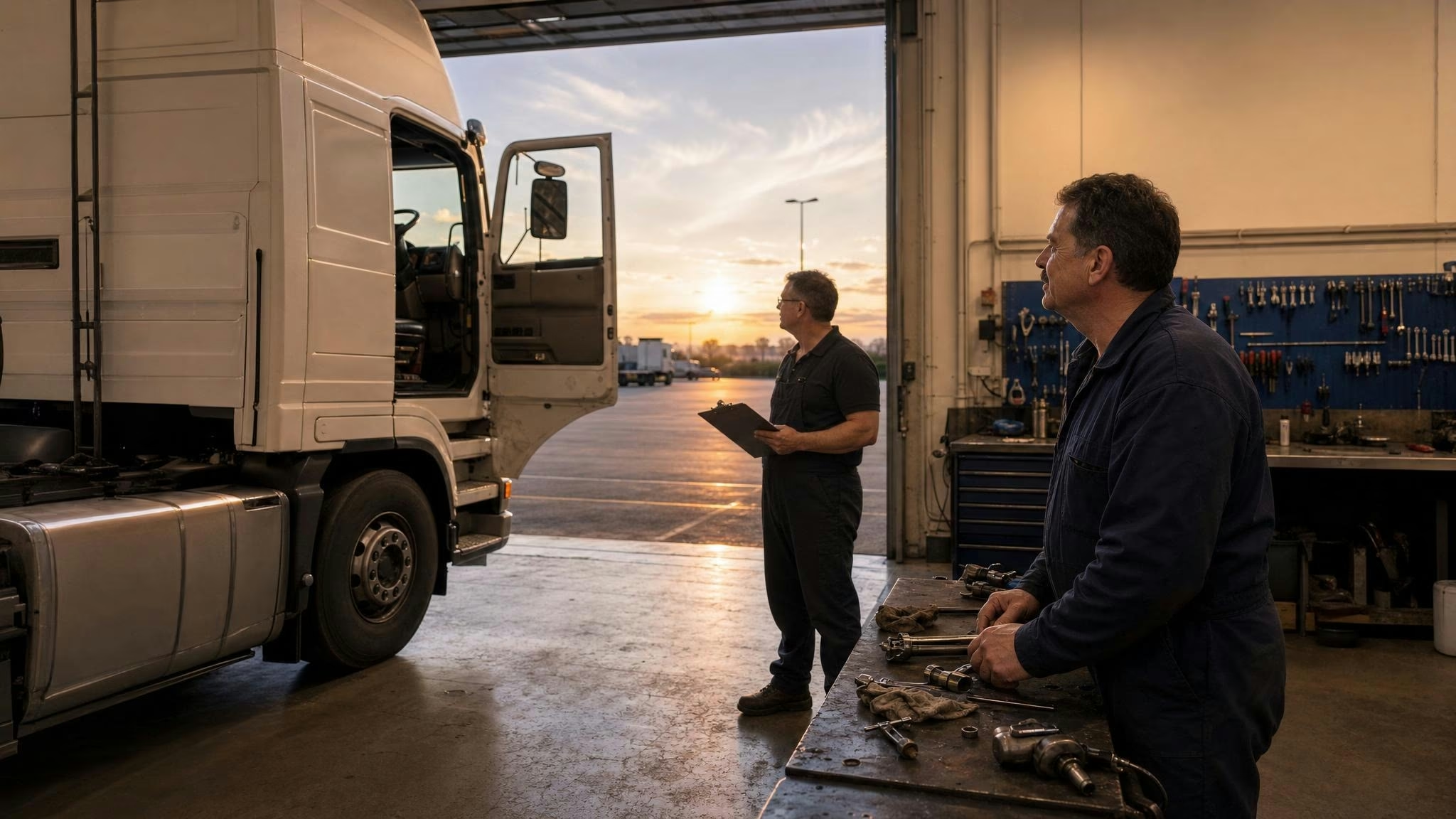
Throughput times are the lifeline of every commercial vehicle workshop. Every hour that a lorry spends in the workshop unnecessarily costs the fleet owner money - and you, in case of doubt, the next job. In practice, commercial vehicle workshops also lose a significant amount of their working time due to unproductive waiting times. Typical causes are missing parts, unplanned diagnoses and unprepared orders. This is precisely where structured workshop management comes in.
| KPI | Target corridor (orientation) |
|---|---|
| Plan/actual deviation per order | < 15 % |
| First-time fulfilment rate | > 85 % |
| Parts availability at the start of work | > 92 % |
| Stage occupancy rate | 75–85 % |
| Average lead time | depending on the order mix |
Initially, five measures can be identified from workshop practice that companies with short lead times have in common.
Firstly, define an internal SLA: you automatically escalate every order that is more than 2 hours over the planned time - line manager informed, customer proactively contacted, alternative plan activated. This one rule alone helps to make overruns transparent and process them in a structured manner. Zero costs, no new tool.
„If you only start a job when the vehicle, parts and technology are ready at the same time, you avoid unnecessary set-up routes and interruptions.“
- Experience from the Alltrucks partner network
Practical Insight: Structured workshop management also means standard-compliant maintenance: the basic concepts and strategies regulate the maintenance of the workshop. DIN 31051 (Basics of maintenance), while you perform the annual expert inspection of the lifting platforms in accordance with DIN EN 1493 (vehicle lifts) must be documented. Anyone who additionally ISO 9001 has already structured the process documentation anyway. In concrete terms: a lorry that arrives in the morning will have a complete damage report, including parts requirements, a few hours later in well-organised workshops. Where this is not possible, however, productive time per order is lost. We are therefore happy to discuss how a structured acceptance process can be set up for your own business. The following also applies to lift compliance EU Directive 2009/104 for the safe use of work equipment - transposed into national regulations - with regular expert inspections.

For transport companies, the downtime of a commercial vehicle is one of the most expensive key figures of all. Unplanned downtime usually lasts significantly longer than scheduled maintenance. This difference is therefore the biggest starting point for the workshop. Those who actively work on it also go from being pure repair service providers to availability partners.
A complete downtime calculation includes direct costs (repair, towing, hire vehicle, hotel costs for the driver) as well as indirect costs (loss of revenue per day of downtime, contractual penalties, reputational damage, scheduling costs). In the industry, it is also regularly emphasised that the breakdown of a long-distance articulated lorry can cause several times the pure repair costs per day - although the exact rates vary depending on the deployment profile. The economic point: per day of downtime, not only the repair but also the entire vehicle contribution margin is cancelled.
The most common causes of unplanned breakdowns are well known from workshop practice: Brake problems, engine and exhaust gas aftertreatment, electrical defects, tyre damage and cooling and air conditioning problems. A timely inspection would recognise and thus prevent a relevant part of these failures. The basic terms for differentiating between inspection, maintenance and repair also define DIN 31051 / DIN EN 13306.
„Customers are willing to pay for predictability. Anyone who promises an appointment and keeps it will be called again for the next order.“
- Experience from the Alltrucks partner network
Practical Insight: Downtime reduction is primarily a data problem, not a workshop problem. Those who analyse the FMS telematics data of their fleet customers often recognise critical fault codes (e.g. Adblue system, EBS, EGR valve) before they actually fail. As a result, he can offer a scheduled appointment instead of a breakdown stop. For 24/7 emergencies, the Alltrucks network also offers Assist24 as a breakdown service; fleet customers with longer-term requirements, on the other hand, can be contacted via the Alltrucks Fleet Programme addressed. We are therefore happy to discuss which module suits your own business. The change in role from reactive repair company to active availability partner is also a key selection criterion for fleet customers - see also European industry analyses, for example from ACEA.

Good scheduling doesn't start in the morning when the lorries arrive - it starts days before, as soon as the appointment is made. Despite this, many commercial vehicle companies still work with handwritten boards, whiteboards or Excel lists, which break down by the third emergency in the morning at the latest. Structured order planning, on the other hand, noticeably shortens throughput times and at the same time improves the first-time completion rate. Alltrucks also uses the Alltrucks Process Compass from.
| Step | Contents | Responsible |
|---|---|---|
| 1 - Qualified appointment request | Record symptom, error codes, vehicle data | Acceptance |
| 2 - Capacity test | Stage slot, special tool, adjust mechanic skill | Disposition |
| 3 - Advance parts planning | VIN-based parts search (Alltrucks VINcat), order before entry | Parts warehouse |
| 4 - Planning the day before | Slot plan, mechanic assignment, handover protocol | Workshop supervisor |
| 5 - Live control | Status maintenance in DMS (Werbas - service partnership), escalation in the event of overdraft | Dispatcher |
| 6 - Post-calculation | Evaluate plan/actual deviation, ensure learning effects | Workshop supervisor |
Professional scheduling is divided into six clearly defined phases. First comes the qualified deadline enquiry, followed by the capacity check and advance parts planning. This is followed by daily planning the evening before, live control by the scheduler and, finally, consistent post-calculation. Each step also has clear responsibilities, defined inputs and measurable outputs. The rule of thumb is therefore: plan a maximum of 80 % of the theoretical capacity - the remaining 20 % are your safety buffer.
For commercial vehicle workshop management, Alltrucks partners rely on a harmonised software ecosystem consisting of service partnerships and Alltrucks' own solutions: Werbas (service partnership) as an established dealer management system with commercial vehicle-specific labour values and multi-platform planning, as well as PleaseFix (service partnership) for the workshop-fleet connection for maintenance and repair, as well as the Alltrucks parts catalogue Alltrucks VINcat for cross-brand parts identification via VIN. The decisive factors here are commercial vehicle-specific labour values (not converted car values), multi-platform planning, interfaces to parts wholesalers and accounting as well as mobile use on the platform - because mechanics must be able to update the order status via tablet.
„Good scheduling doesn't start in the morning when the lorries arrive - it starts three days before, when the appointment is made.“
- Experience from the Alltrucks partner network
Practical Insight: The handover quality between the receiving department and the workshop is one of the most underestimated factors for order productivity. Orders with fully documented pre-diagnosis (photo, fault codes, symptom description, parts list) generally run with less deviation between planned and actual values than incomplete orders. Workshops that actively structure their handover gain back productive time without accepting an additional order. The investment: a structured acceptance form and brief training for each employee.
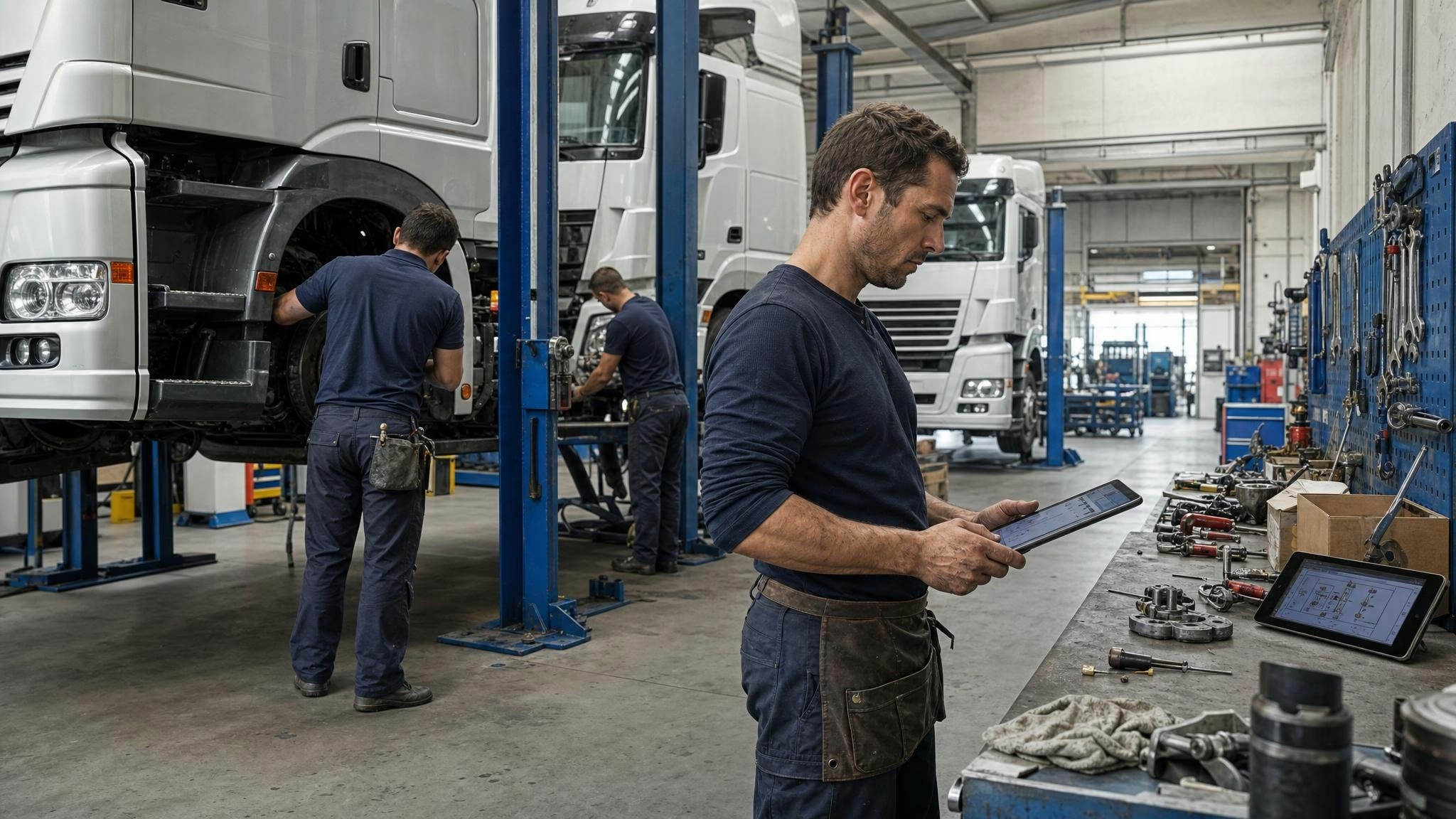
The reality in commercial vehicle workshops: on Mondays the workshop is overflowing, on Wednesdays the bays are empty and on Friday afternoons nobody wants the last job. The fluctuation in capacity utilisation between the busiest and weakest days of the week is considerable in many businesses and also costs money. Smoothing out the degree of capacity utilisation and raising it to a realistic target corridor, on the other hand, generates additional sales without a new stage and without new customers. A sensible target corridor is therefore around 80 % of the available productive time - above this, planning will collapse at the first emergency.
Before you can optimise, you first have to measure - and measure correctly. Three terms are part of the mandatory vocabulary of every workshop manager: Attendance time (e.g. 8 hours/day), Available productive time (attendance minus breaks, meetings, set-up and clean-up times - realistically 6-6.5 hours/day) and Productive time sold (the hours invoiced to the customer - the hard figure). The productivity level should therefore be at least 85 %.
Let's do the maths: 6 mechanics × 6.5 productive hours equals 39 billable hours per day. At 70 % utilisation, that's 27.3 hours sold, whereas at 82 % it's 32.0 - a difference of around 4.7 hours per day. With 22 working days per month, that is also around 103 additional hours per month, or around 1,240 billable hours over the year. However, which target value is realistic for your own company depends heavily on the order mix and staff structure.
„Often, the greater effect is not in new stages, but in better utilisation of existing capacity - with a digital planning tool and a short training period for the team.“
- Experience from the Alltrucks partner network
Practical Insight: In many workshops, the key figure „capacity utilisation rate“ alone masks the actual inefficiency driver: it is not the stage occupancy rate, but the Hourly rate realisation. In practice, a relevant proportion of the hours worked cannot be invoiced directly (warranty, rework, internal tasks, loss of breaks, set-up times) - how high this proportion is, however, is highly dependent on the company. The most effective adjustment: daily timesheet review by the workshop manager. If you analyse the unaccounted hours of the day every evening, you can identify the recurring causes of loss within a few weeks and address them in a targeted manner.
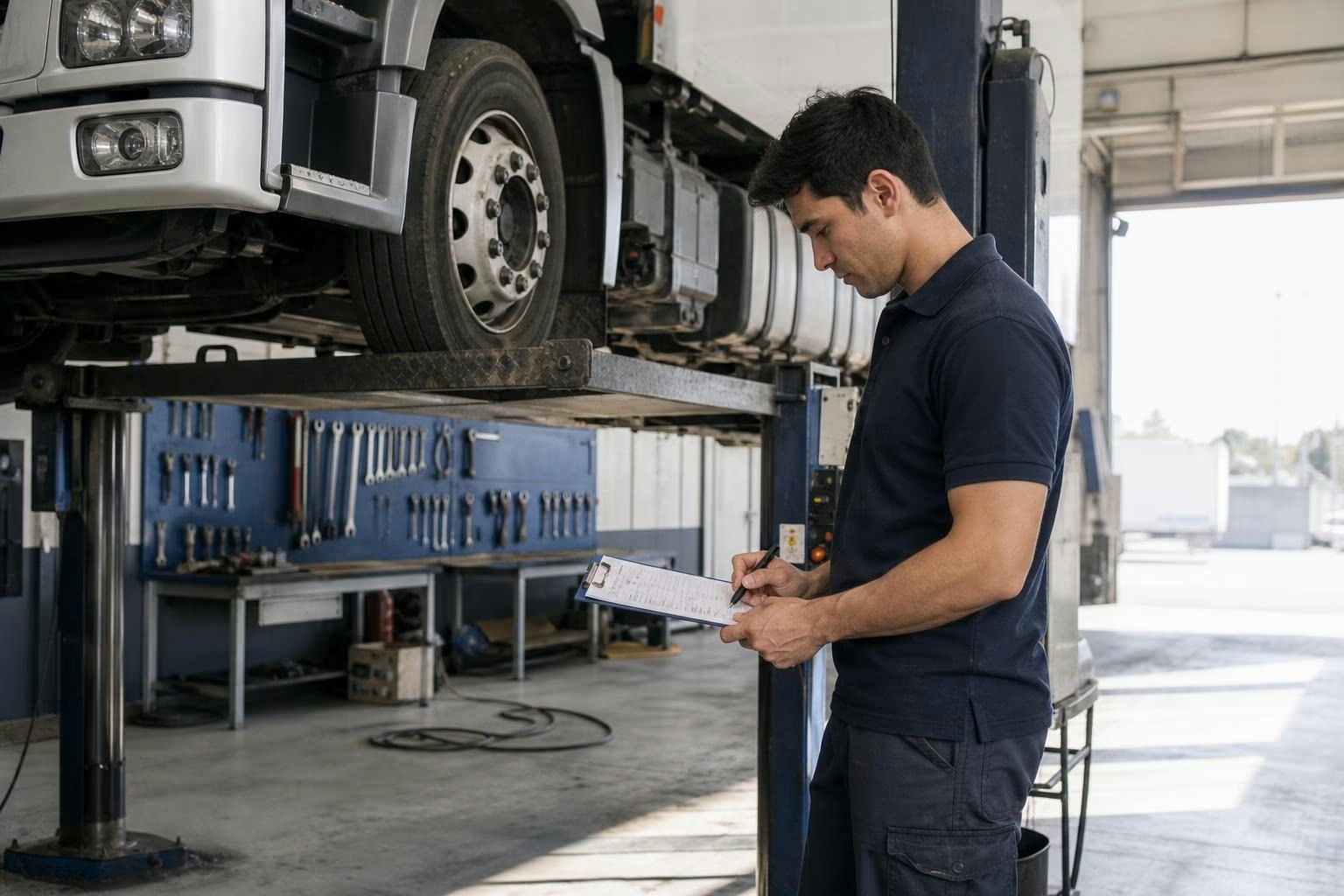
Workshop management does not end with processes and software; it begins with the physical equipment. The lift is the centrepiece of any lorry workshop: without it, brake servicing, chassis diagnostics and underbody inspections come to a standstill. At the same time, it is one of the most capital-intensive investments for a commercial vehicle workshop — and subject to a high degree of regulatory standardisation. Anyone who plans incorrectly in this area or ignores inspection requirements ties up capital in unsuitable technology and risks liability claims. Alltrucks partners wishing to compete with similar workshops in this field benefit from partner terms at WESP CV thanks to its close ties to its founding company, Knorr-Bremse.
Lifting platforms are subject to a comprehensive set of rules: The EU Directive 2009/104 for the safe use of work equipment is transposed into national regulations and also stipulates regular inspections by a competent person (typically annually). In addition, there are national operational safety regulations (risk assessment) and country-specific additional regulations for mechanical, hydraulic and electrical components. Additional qualification requirements also apply to high-voltage work on electric lorries. The annual expert inspection is therefore a plannable maintenance module for each platform. In addition, quarterly visual inspections and semi-annual functional tests are recommended - all fully documented in the inspection logbook.
A second lift increases the parallel order throughput. With stable capacity utilisation and a standard market hourly rate, a stamp lift typically pays for itself within the first or second year of operation - although the exact timing depends heavily on the order mix and daily organisation. There are also indirect effects: fewer order rejections, shorter throughput times, more satisfied fleet customers.
„The second lifting platform paid for itself much more quickly than we had anticipated - not because we took on more orders, but because we were finally able to process orders in parallel instead of sequentially.“
- Experience from the Alltrucks partner network
Practical Insight: Garages that think strategically about their lift procurement rather than purely from a regulatory perspective are better positioned in the long term. E-truck capability is also no longer optional: for High-voltage work national qualification rules apply (derived from EU 2009/104) as well as international standards for HV mould equipment IEC 60364 and IEC 60900. Those who purchase conventionally, on the other hand, risk a more expensive retrofit. Three criteria therefore help with any new investment: HV suitability, software update capability (CAN interface) and multi-axis synchronisation for 8×4 configurations. You should also factor in ongoing expert costs (approved testing organisations) as a fixed maintenance item.