Reduce costs sounds like sacrifice, cost-cutting measures and a loss of quality. In reality, the opposite is the case. Those who know and optimise their cost structure create financial leeway for better equipment, higher wages and future-proof investments. In many Commercial vehicle workshops There is recognisable potential for savings in this area, but not by compromising on quality. Rather, it comes from eliminating waste, renegotiating overpriced contracts and optimising processes. Industry comparative values from European workshop associations also show recognisable ranges between companies of the same size. Methodologically, structured cost reduction programmes can be applied to the DIN EN 13306 (European standard on maintenance terms) and established full-cost accounting methods.
Practical experience from the Alltrucks partner network shows: Anyone who carries out a structured cost analysis once a year usually finds several starting points for cost optimisation. Neither service quality nor customer satisfaction suffer in the process. This article firstly shows where the biggest drivers lie and how they can be utilised. The margin gained also flows directly into your Workshop profitability. Methodologically, the approach is therefore based on established calculation procedures from national vocational training in the commercial vehicle industry.
Rule of thumb: In a typical commercial vehicle workshop, 50-60 % of total costs are attributable to personnel, 20-30 % to materials and parts, 10-15 % to premises costs and energy and 5-10 % to administration, IT and other. However, experience has shown that the greatest savings potential does not lie in the largest cost block, i.e. personnel. Rather, they are to be found in materials and energy, as this is where optimisation is least likely to take place.
Workshop costs are the total of all fixed and variable costs for operating a commercial vehicle workshop. They include personnel, parts, energy, buildings, depreciation and IT. A transparent cost structure is therefore a prerequisite for reducing commercial vehicle workshop costs and maintaining a healthy margin in commercial vehicle servicing.
What is the cost structure of a commercial vehicle workshop?
Before you can make savings, you need to know where your money is going. This may sound banal, but in practice many companies lack a detailed cost overview. The BWA from the tax consultant only comes quarterly and shows totals. However, it does not reveal which items should be scrutinised.
Fixed costs: The base that always runs
Fixed costs are incurred regardless of capacity utilisation. These include rent or lease, leasing instalments for equipment, salaries (including non-productive employees such as office staff), insurance, basic IT fees and depreciation. In a typical commercial vehicle workshop with 5 mechanics, fixed costs also regularly account for 55-70 per cent of total costs. This means that you have to generate this amount every month before the first contribution margin flows into the profit.
Variable costs: this is where the greatest room for manoeuvre lies
Variable costs rise and fall with the order volume. These include spare parts, consumables, energy (at least in part), disposal and order-related external services. The advantage of this is that savings on variable costs have an immediate and direct effect on each individual order. If you reduce your parts maintenance costs by 10 per cent, for example, the contribution margin of each order improves by this amount at the same sales price.
What are the 3 biggest cost drivers and how can they be reduced?
| Cost item | Share | Optimisation approach |
|---|---|---|
| Personnel costs | 48 to 55 per cent | Productivity and capacity utilisation |
| Parts and material | 18 to 24 per cent | Framework agreements and identical parts |
| Room costs and energy | 9 to 12 per cent | LED and heating control |
| Depreciation of equipment | 7 to 10 per cent | Life cycle planning |
| IT and software | 3 to 5 per cent | Cloud consolidation |
| Insurance and administration | 4 to 7 per cent | Framework agreements |
Cost driver 1: Unproductive staff time
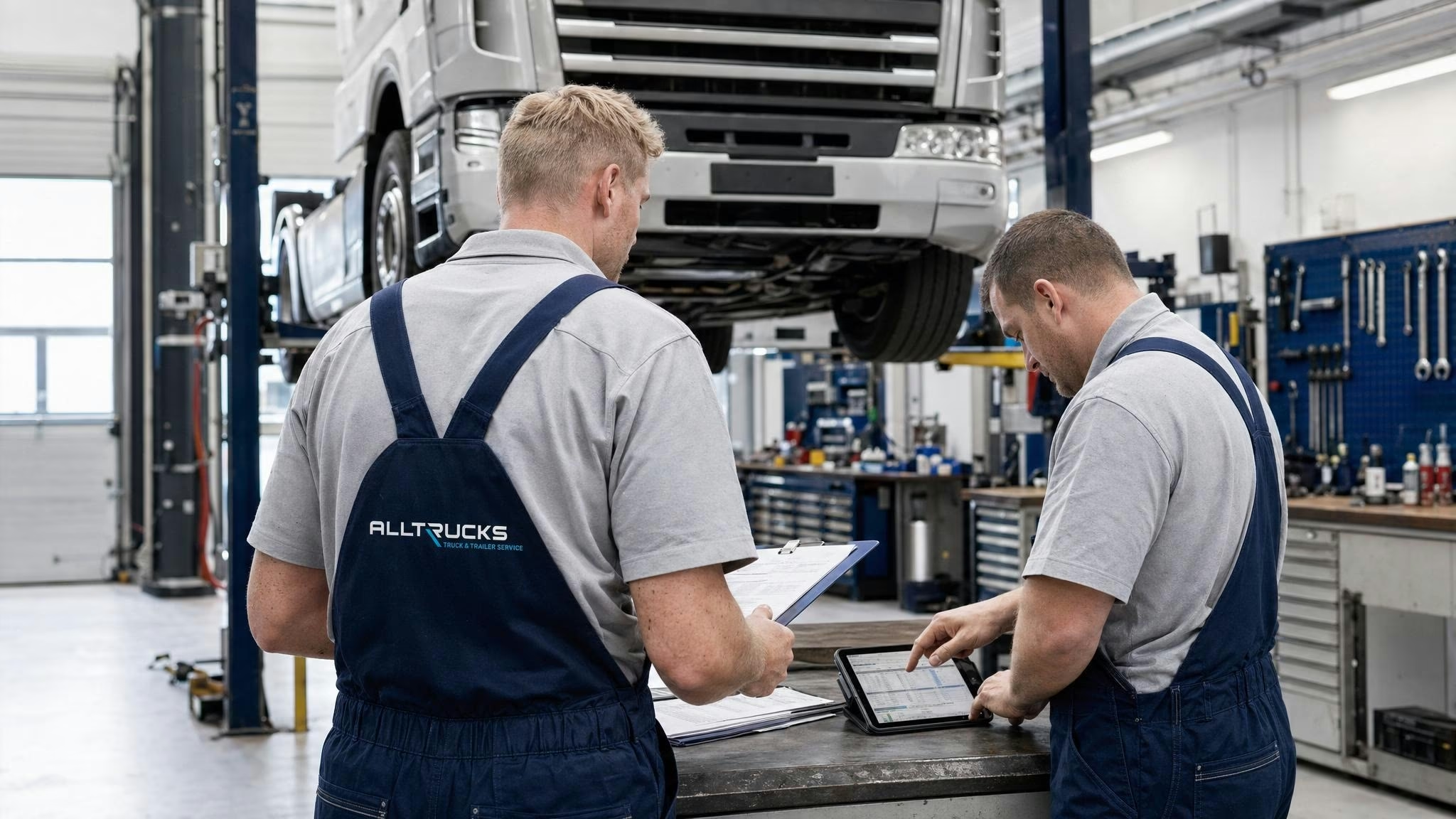
Personnel is the largest cost item. However, reducing personnel costs does not mean cutting wages or laying off employees. Rather, the real driver lies in the ProductivityHow many of the paid hours are actually invoiced? Every percentage point more invoiced hours has a direct effect on the contribution margin. These hours are not saved, but generated additionally. A structured acceptance and order organisation also helps to make unproductive times visible.
Several measures increase productivity: prepared orders (parts picked in advance, work instructions ready), reduced set-up times thanks to an optimised workshop layout and fewer interruptions thanks to clear responsibilities and a short daily briefing. You can also find detailed strategies in the article Improve throughput times. Incidentally, staff turnover is one of the biggest hidden cost factors - more on this at Retain employees.
Cost driver 2: Parts purchasing at list prices
Many commercial vehicle workshops purchase spare parts at conditions that are significantly higher than what would be possible with negotiation and strategy. The main reasons for this are: no framework agreements, too many individual orders, no systematic price comparison and emotional supplier loyalty („We've been ordering from Müller for 20 years“). You can also find a detailed analysis of purchasing strategies in the article Procuring spare parts at favourable prices.
The Alltrucks partner network can also be used to structure parts purchasing. The Alltrucks VINcat spare parts catalogue enables fast, precise and efficient searches for spare parts.
Cost driver 3: Energy costs in workshop operations
In recent years, energy costs have risen to become the third largest cost block for many workshops. A typical commercial vehicle workshop with 600-1,000 m² of hall space also consumes 80,000-150,000 kWh of electricity and 100,000-200,000 kWh of gas per year. This is where the greatest savings potential lies:
- Compressed air: Leaks in the compressed air system cause double-digit percentage losses in compressed air production in a typical workshop. A professional leakage test therefore pays for itself within a few months.
- Lighting: Switching to LED significantly reduces lighting costs; the investment also typically pays for itself within the first financial year.
- Hall heating: Infrared dark radiators instead of warm air heating reduce heating costs noticeably, as they heat the workstations specifically and not the entire hall air.
- Hall doors: High-speed doors instead of conventional sectional doors also significantly reduce heat loss when opening.
„Three classic measures - eliminating compressed air leaks, LED lighting, high-speed doors - regularly reduce annual energy costs by around half. Amortisation is typically in the single-digit annual range. Everything after that is pure margin.“- Practical observation from the Alltrucks network
How can workshop costs be reduced through process optimisation?
Not every saving requires an investment. Many costs are caused by inefficient processes, and these can be reduced with organisational measures. If you want to delve deeper, you can also find out more in the article on Optimise throughput times Further information.
Optimise warehousing
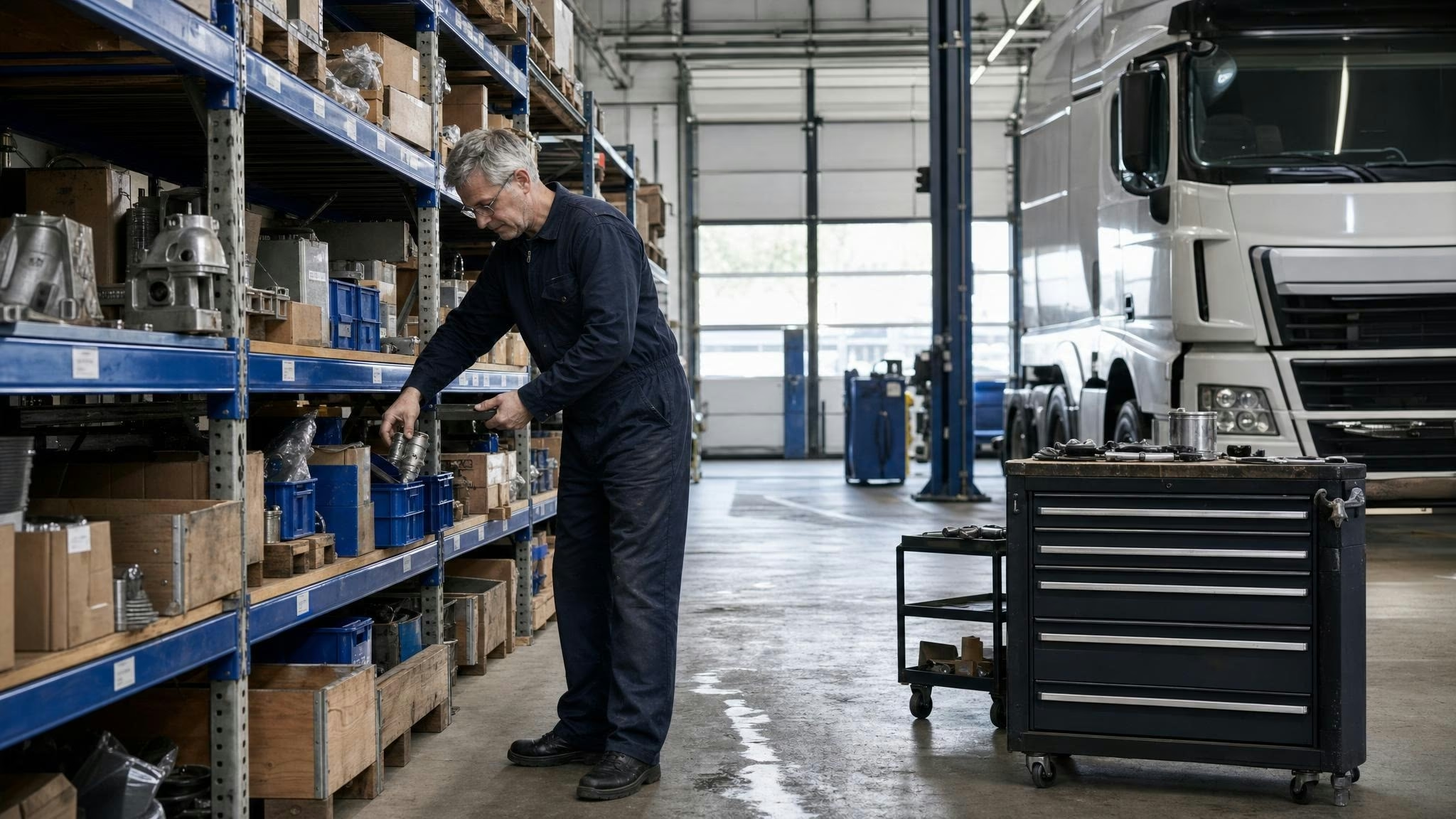
An overfilled warehouse ties up capital and causes costs for space, insurance and shrinkage. An empty warehouse, on the other hand, leads to rush orders and waiting times. The solution therefore lies in the middle: Firstly, define minimum and maximum stock levels for your top 100 fast-moving items. Also use the ABC analysis. A-parts (high consumption) should be kept in stock, B-parts (medium consumption) should be purchased from wholesalers with short delivery times and C-parts (low consumption) should only be ordered on an order-by-order basis. Optimally managed warehousing therefore reduces capital commitment by 20-30 per cent while at the same time increasing availability.
Control tool costs
Tool loss and wear cause a significant annual cost factor in the mid single-digit percentage range of equipment costs in a typical commercial vehicle workshop. Several countermeasures can help: personal tool sets for each mechanic (increases accountability), regular inventory (quarterly) and quality tools instead of cheap goods (lasts 3-5 times longer). Shared use via workshop co-operations or the Alltrucks network is also worthwhile, especially for special tools.
Reduce administrative costs
Paper processes, duplicate data entry and manual invoicing cost time and therefore money. An integrated workshop management system (DMS), on the other hand, automates order entry, time booking, parts ordering and invoicing. Service partnerships in the Alltrucks network also provide Werbas (DMS service partnership) and PleaseFix (for the workshop-fleet connection) are available as established modules. In conjunction with the Alltrucks VINcat (spare parts catalogue for searching via the VIN), the parts search can also be systematised. The amortisation of a DMS investment is therefore typically in the first to second year of operation.
Quick-win checklist: Three immediate measures you can take to reduce commercial vehicle workshop costs without investing: 1. first check all insurance policies for overlaps and excessive sums insured. 2. also compare your electricity and gas tariffs with current market offers. 3. finally, cancel unused software subscriptions and service contracts. Experience has shown that these three measures significantly reduce annual overheads and licence costs; however, the actual amount depends on the current status of each company.
When is investing smarter than saving?
The most sustainable form of cost reduction is often a targeted investment.
You should therefore evaluate every investment using the amortisation calculation: investment sum divided by annual savings (or additional turnover). Anything under 24 months amortisation is therefore a good investment in the workshop sector. Anything under 12 months is also considered a no-brainer.
„Saving is important, but if you only save, you shrink. The trick is to invest where every hour spent comes back several times over - a second four-pillar stage or the Alltrucks Multi-brand diagnosis (KTS Truck V3) are amortised in the first to second year of operation.“- Practical observation from the Alltrucks network
- Firstly, create a complete cost breakdown - broken down into fixed and variable costs.
- Then identify your three largest cost items by personnel and check each for potential savings.
- Also have a compressed air leakage test carried out (ROI typically less than 6 months).
- You can also compare your energy tariffs and insurance conditions with current market offers.
- Also check your parts purchasing conditions - please contact us for specific Alltrucks partner conditions.
- Finally, evaluate upcoming investments with the amortisation calculation and prioritise according to ROI.