Accident damage is not covered by the Lorry workshop rarely day-to-day business - and that's exactly what makes them risky. Those who only occasionally deal with comprehensive and liability cases do not know the pitfalls in detail: incomplete preservation of evidence, unjustified reductions by the insurance company, months of advance payment and, in the end, reminders that reach the customer because something was overlooked in the process. According to German Insurance Association (GDV) The settlement of a motor vehicle liability claim (the insurance law category also includes commercial vehicles) takes around three weeks on average - significantly longer in disputed cases.
The Zweig car dealership in Stuttgart has been familiar with this situation for a long time - until it was Alltrucks claims management has switched to structured processing. This article documents the Stuttgart workshop's journey, the mechanisms behind the changeover and the effects on turnover, liquidity and customer confidence. Anyone interested in the Hourly rate calculation and the Increase in contribution margin often overlooked in claims management.
The key message from Stuttgart: „We gave away a lot of money due to uncertainty and ignorance.“ - Shoruna Korus, employee at Zweig car dealership. The starting position of many workshops is identical. The difference lies in whether the process is set up in a structured way or not.
Why claims settlement is a risk for independent garages
The hurdle does not lie in the repair itself - every commercial vehicle workshop can handle that. It's the commercial and legal processing that makes it difficult: different insurers, different clerks, changing contact persons, partial commitments over the phone without any written trace. In addition, there are reductions that are not checked in day-to-day business because the staff are not available. on the lifting platform and not at the desk.
Administrative burden instead of productive hours
Experience has shown that an unstructured claims file ties up several hours of commercial staff per case: for phone calls, emails, expert appointments, checking reductions, clarification with customers. These hours are lost elsewhere. Workshop managers know the maths: every hour of administration is an hour that is not spent on order acceptance, post-calculation or customer care. The ZDK regularly points out in its company comparisons that administration shares are the hidden margin killer of independent garages.
Unauthorised reminders to customers
It becomes particularly tricky when the overview of the case status is lost. Reminders are sent to customers because it is not documented internally that the insurance company is settling the outstanding amount. This damages trust and cannot usually be fully repaired, even with subsequent communication. This was a recurring problem at the Zweig dealership.
Advance payment without planning security
Material has been installed, hours have been worked - the money is with the insurance company. If you don't have a structure for processing, you fall into the liquidity trap: the invoice has been issued, payment is outstanding, the working capital is tied up in claims files instead of in billable orders. With five parallel cases of a typical size, the company quickly ties up substantial capital.
„Communication with insurance companies was an administrative nightmare. Particularly critical: unauthorised reminders sent to customers because no one had an overview of the exact status of claims processing.“- Shoruna Korus, employee at Zweig car dealership
The digital claims portal: a centralised file for all parties involved
The first structural starting point is of a technical nature: a digital claims portal via which all parties involved - workshop, expert, lawyer and, in the background, the insurance company - have access to the same status. No parallel email chains, no PDF attachments in different mailboxes, no unanswered questions about documents that „someone“ already has.
What is stored in the portal
Damage report, photos of the damage site, expert reports, work orders, spare parts certificates, correspondence with the insurance company, reminder status: everything in one file, chronologically and with role authorisations. The expert - in Zweig's case, the workshop works with Moritz Müller, an expert in the Stuttgart area - uploads his reports directly to the portal. This saves the diversions via PDF mail and ensures that the lawyer has access at the same time.
Why this is more than just a DMS
A normal Workshop management system documents orders. A claims portal documents the preservation of evidence and the course of the process - two different data models. The „lawyer“ role with read/write access to certain document types, the linking of cost estimates, expert opinions and assignment declarations with the claim and the traceability of dunning stages do not belong in a DMS, but in a specialised tool.
Define a responsible person in the workshop as the person in charge of the portal - typically the commercial manager or service assistant. A second contact person as a stand-in prevents downtime during holidays or illness.
Expert opinion or cost estimate: what the difference is
A recurring point of contention: the insurance company insists on a Cost estimate (KVA) instead of an expert opinion. The reasoning sounds understandable („We save the expert's fee“), but the effect is often detrimental for the workshop and the customer.
| Criterion | Cost estimate | Expert opinion |
|---|---|---|
| Preservation of evidence in court | none | legally compliant |
| Impairment documented | no | Yes |
| Previous damage recorded | only partially | systematic |
| Recognisable total economic loss | no | Yes |
| Reductions due to insurance | easily possible | Rarely enforceable |
| Cost unit | Workshop/Customer | Liability insurer |
Particularly in the case of higher amounts of damage or cases with technical depreciation, the expert opinion is not an optional extra, but the correct factual basis. Moritz Müller puts it soberly in Stuttgart: „Without an expert opinion, the insurance company can make drastic cuts.“
„Insurance companies often insist on a cost estimate because they want to save the costs of an expert opinion - with negative consequences for the workshop and the customer.“- Moritz Müller, expert for commercial vehicles, Stuttgart area
Financial security: assignment, advance payment and unauthorised lump-sum deductions
The second structural driver has a direct impact on liquidity. The central element is the Declaration of assignmentThe injured customer assigns their claim against the opposing liability insurance company to the workshop or the appointed lawyer. From this moment on, communication with the insurance company no longer goes through the garage or the customer - but directly through the law firm.
Claims recording and declaration of assignment
When the accident vehicle is accepted, the damage report is documented, the expert is informed and the customer signs the declaration of assignment. The case is then legally stored in the portal.
Expertise and repair approval
The expert documents the extent of the damage, depreciation and previous damage. As soon as the appraisal is in the portal, approved and reported to the insurance company, the workshop can start repairs.
Processing by the law firm
The law firm - in the case of Alltruck's claims management, the network works with PHP Rechtsanwälte - handles communication with the insurance company, checks deductions, claims unjustified deductions and manages payment.
Receipt of payment before completion of repair
In structured cases, the money is often in the workshop's account before the repair is completed. The liquidity trap of „advance payment over months“ disappears.
Decision to take legal action - only if it is worthwhile
If the insurance company reduces or does not pay despite proper documentation, the law firm makes a recommendation as to whether it makes economic sense to take legal action. In around 95 % of cases, the claim is settled without legal action.
Hidden losses: unjustified lump-sum deductions
One item that is often overlooked are the small, unjustified deductions that insurance companies make when settling claims - transport costs, UPE surcharges on spare parts, cleaning and inspection fees, minor ancillary expert costs. Each individual reduction seems manageable. In total, these are four-digit amounts over the year that are simply lost by many garages because the individual follow-up is time-consuming and is at the bottom of the priority list.
This is precisely where specialised legal processing comes in: Unauthorised flat-rate deductions are systematically checked and reclaimed. There is no additional work for the garage - the result is credited directly to the account.
„Thanks to Alltruck's claims management, we now often receive the money before the repair has been completed. We used to hesitate when an accident vehicle arrived. Today we say: great, we'll give it straight to PHP.“- Katharina Braun, Managing Director Autohaus Zweig
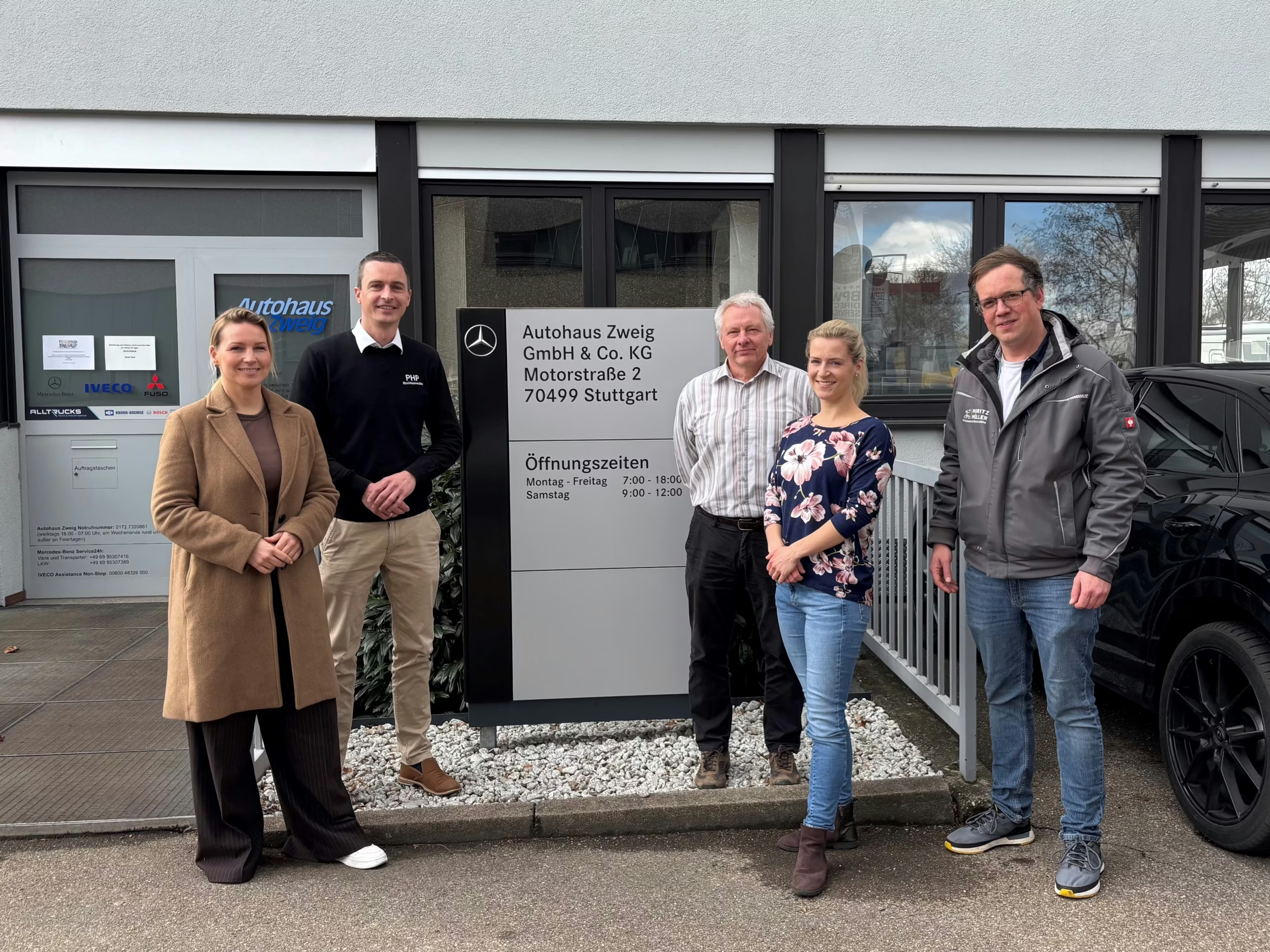
Case study: The Zweig car dealership in Stuttgart
What Alltrucks partner workshops can now do differently
Switching to a structured claims management system is not a major project - it is rather a series of comprehensible decisions that, in total, will minimise the risk of loss. Economic side of the workshop stabilise.
- Check how many claims you have per month - and how much commercial capacity they tie up.
- Talk to your Alltrucks system consultant about Alltrucks claims management if you are interested.
- Alltrucks claims management is currently available for German Alltrucks partners.
For Alltrucks partners, the Liability processing in the network free of charge - the administrative and legal effort is centralised. Those who also participate in the Cost structure and to shorter throughput times moves three result adjustment screws simultaneously.
The examples presented are not a substitute for individual legal advice and do not replace an examination of the respective contractual and insurance conditions of the individual company.
„Initially, we were also sceptical as to whether it was worth the effort. After the experiences of the last few months, I can only advise every Alltrucks partner to try it out. There's nothing to lose - but a lot to gain.“- Katharina Braun, Managing Director Autohaus Zweig