A replacement typically costs a commercial vehicle workshop several months' salary. This is calculated from recruiting, familiarisation, loss of productivity and overtime for the remaining team. If you lose a good mechatronics technician, you not only lose a human resource, but also experience, customer loyalty and team stability. Employee retention is therefore not a feel-good discipline, but a hard economic parameter. It is also one of the most effective levers in the Reduce workshop costs. The good news is that most reasons to stay cost far less than any pay rise. This is because they are a question of attitude, structure and consistent implementation. Industry-internal surveys on vocational training show this development particularly clearly in the commercial vehicle sector. Employee retention in the workshop is linked to the ergonomic and work organisation requirements of the DIN 33403 (climate at the workplace) and the DIN EN ISO 6385 (principles of ergonomics).
HR structures in the Alltrucks network are based on specific modules. Firstly, the Alltrucks training courses (levels 1/2/3) structure the qualification from entry to in-depth system expertise. In addition, certification as a multi-brand system technician makes the development path in the company visible. In addition, the national vocational training systems provide a structured programme for independent workshops.
Employee retention is the totality of measures aimed at retaining qualified employees in a commercial vehicle workshop in the long term. It includes pay, career paths, working environment and management culture. In an industry with a growing shortage of skilled labour, it is also the most important economic factor after the pure order situation in the company.
Why do mechatronics engineers really quit?
If you want to retain employees, you first need to understand why they leave. The assumption that money is the main reason is persistent. However, it often falls short. In many exit interviews, a different picture emerges. Before money, issues such as a lack of appreciation, poor leadership, overwork and the feeling of being stuck in a dead end are regularly mentioned.
The five most common reasons for cancellation
- Lack of appreciation in everyday life: Anyone who never hears a „thank you“ for extra work, gets no feedback on their own work and has the feeling of being replaceable will look around - even if the salary is right.
- Conflicts with the direct manager: Employees rarely leave companies, they leave superiors. A workshop manager who does not listen, makes arbitrary decisions or comments publicly on mistakes is the most frequent trigger for dismissals.
- Chronic overload: When every day ends in the red, breaks are cancelled and weekends become the norm, staff burn out. Burn-out is no longer a marginal phenomenon in the commercial vehicle trade.
- Stagnation instead of development: Mechatronics engineers want to grow. If you are still doing the same tasks after three years, have the same responsibilities and receive no training, you feel left behind.
- Lack of identification with the company: If employees do not understand what their workshop stands for, what values apply and where the journey is heading, they lack an emotional anchor.
„We made the wrong adjustments for three years. Higher bonuses, more holidays - the fluctuation remained. It was only when we started deliberately talking to every employee for two minutes every morning that the mood changed."- Workshop manager from the Alltrucks partner network
Why is appreciation the underestimated currency of loyalty?
| Channel | Reach | Qualification quality |
|---|---|---|
| Employee recommendation | regionally limited | high - pre-filtering by team |
| Public employment agency | regionally broad | mixed - strongly location-dependent |
| Social media (Facebook, Instagram) | regionally broad | Mixed - Attention ≠ Suitability |
| Job portals (Stepstone, Indeed) | supraregional | wide - high filtering effort |
| Recruitment abroad | supraregional | high with suitable integration |
| Training and takeover | regionally targeted | very high - company knows candidate |
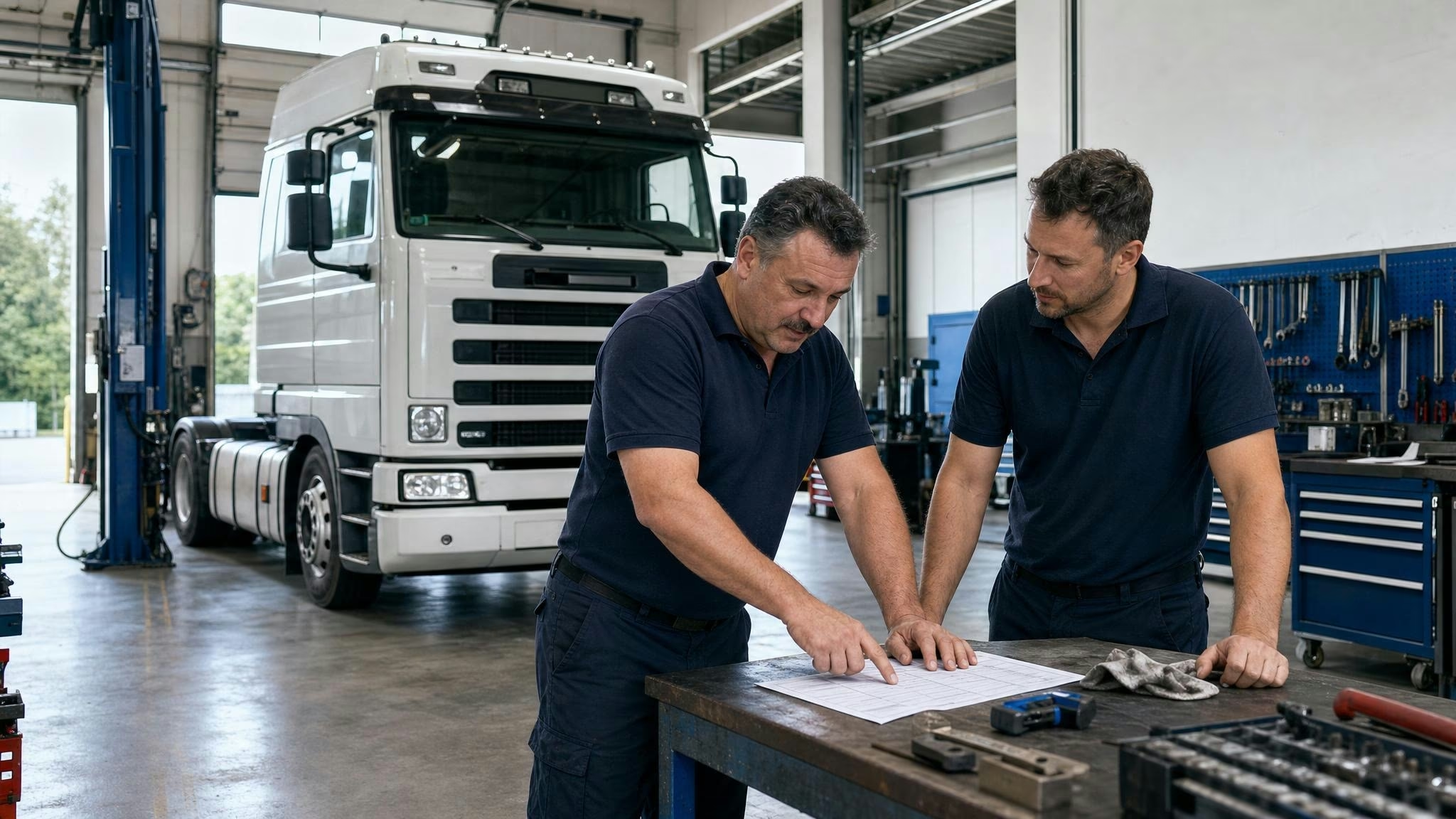
Appreciation is not a vague term because it has a clear definition. Appreciation means recognising a person as a person and their performance as valuable, expressing this and backing it up with action. In everyday workshop life, however, this is often forgotten because the pressure is high and time is short. But small gestures can make all the difference when it comes to building loyalty, especially where there is a daily crisis.
Making appreciation visible
The most effective forms of appreciation are also the simplest. However, they must be consistent:
- Daily greeting with eye contact: Sounds banal, but it's the gold standard. Every employee is greeted personally in the morning, addressed by name and briefly recognised.
- Specific praise based on performance: Not „well done“, but „The fact that you stayed on until 7 pm yesterday with the axle damage and the customer was able to drive today - that was great. Thank you.“ Concrete praise is much more effective than a cliché.
- Share successes publicly: Successfully completed major repairs, solved diagnostic puzzles or positive customer feedback belong in the team round, on the pinboard, in the internal chat.
- Discuss errors in private: The reverse rule: praise publicly, criticise privately. Humiliating employees in front of colleagues destroys in a minute what has taken months to build.
Introduce a weekly „appreciation round" in the team. Each team member names one thing for which they were grateful to a colleague in the past week. This is unusual at first. Over time, however, it often becomes a simple building block that noticeably characterises teamwork.
How do workshops make career prospects visible?
„From journeyman to workshop manager“ - that sounds good in a job interview. In most workshops, however, this path only exists in theory. Employees therefore need concrete, plannable development steps. Anyone who does the same job for three years without anything changing will lose motivation - no matter how good the mood in the team is.
Offer structured development paths
Professional career planning does not necessarily mean that every employee has to become a workshop manager. Development can also go in depth. In fact, this is often more attractive:
- Professional specialisation: Diagnostics specialist, high-voltage expert, axle professional, hydraulics manager - anyone who can build up a specialisation becomes an indispensable pillar of the company and identifies more strongly with their role.
- Management career: Shift leader, team coordinator, workshop manager, branch manager - with clear job profiles, defined transition phases and targeted further training.
- Transverse development: From workshop mechanic to order acceptance, technical sales or the training department - not everyone wants to work on lorries, many discover new talents.
- Instructor role: Experienced mechatronics engineers who train the next generation take on responsibility and experience a new sense of purpose in their work.
The development dialogue as a mandatory appointment
Every employee should have a structured development meeting at least once a year. Not on the spur of the moment, but with an appointment, preparation and written agreement. Three questions take centre stage: Where are you now? Where do you want to go? What do you need from us to get there? Anyone who takes these discussions seriously is signalling: You are more than just a pair of hands.
A structured development meeting is often the point at which a „job" becomes a development path again. Signalling to employees at least once a year that their next steps are being planned lays the foundation for a stable relationship between the company and the team.
Why is further training the most important anchor of loyalty?
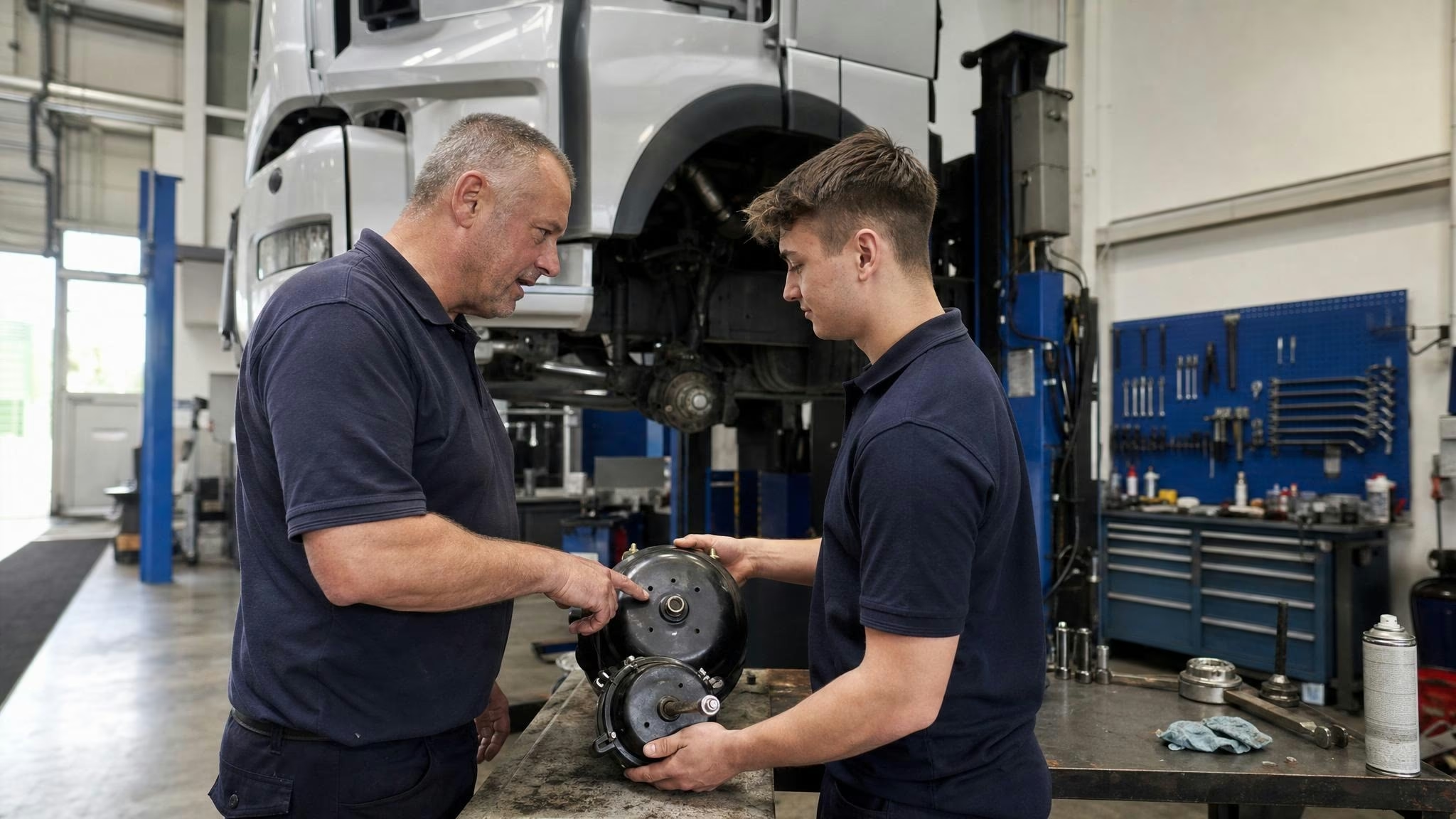
Investing in further training is the most effective form of appreciation with a long-term effect. Sending an employee on a two-day high-voltage training course says: „We believe in you, we invest in you, we want you to grow with us.“ At the same time, the team's qualifications increase, which in turn increases the workshop's competitiveness. This is therefore a rare win-win situation.
Plan a structured training budget
Include a defined training budget per employee in the annual plan - as a fixed amount, not as a residual amount that is cancelled when things get tight. Suggested topics:
- Diagnostic updates for new truck generations from major manufacturers
- High-voltage qualification level 2 and 3 for e-truck service
- ADAS calibration and driver assistance systems
- Telematics, connected truck and digital order processing
- Air conditioning expertise and refrigerant handling
- Soft skills: customer communication, conflict management, team leadership
Qualification and certification in the Alltrucks network
There is a robust framework for workshops in the Alltrucks network. The Alltrucks training are structured in three levels - Level 1 (basics of multi-brand service), Level 2 (in-depth system expertise and PIN authorisations, e.g. Bosch PIN 2 for trailers and Knorr-Bremse PIN TEBS 4) and Level 3 (special topics and trainer roles). Those who pass through the levels can then take the Certification as a multi-brand system technician aspire to. This is more than just a certificate on the wall, because it is a visible career step that makes the development path in the company concrete.
Before a training budget is allocated, it is worth taking a clear look at the current situation in the team: who can do what safely, where are routines missing, which systems are due to be implemented in the coming months? We will be happy to discuss together which training level suits the company and how an annual plan should be structured.
„When we guaranteed each mechanic a fixed quota of paid training days - and allowed them to choose the topics themselves - the mood in the team changed noticeably. Training suddenly became a visible sign that we were investing in our people."- Experience from the Alltrucks partner network
What feel-good factors in the workplace keep mechanics on the job?
A mechatronics technician spends eight to ten hours a day in the workshop. The way this place is organised therefore has a greater impact on mood, health and the likelihood of staying than many workshop operators would like to admit. It's not about lounge furniture and table football, but about basic principles that communicate appreciation.
The invisible bonding factors
- Cleanliness and tidiness: A tidy workshop with clear structures signals professionalism and respect for the mechanics' work. Dirty staff rooms are a frequent reason for dismissal.
- Modern, functional tools: If you have to work with broken tools, you don't feel taken seriously. Investing in high-quality tools pays off twice over - through productivity and loyalty.
- Climatic conditions: 38 degrees in the hall in summer and freezing cold lifting platforms in winter - workshops don't have to put up with this. Industrial fans, insulated hall sections and heated work areas are not luxury investments.
- High-quality social area: Tidy break rooms, clean sanitary facilities, fresh drinks, a decent coffee machine. Every investment here pays for itself several times over.
- Personal equipment: Your own tool compartment, your own work clothes in the right size, a locker that doesn't jam - the sum of many small things.
Ask your team directly: „What annoys you most here every day - what would you change immediately if you could?" Start by writing everything down, sort by effort and then implement the first three measures promptly. The mere fact that you are listening and taking action will improve the mood in the long term.
Which remuneration models really motivate?
Money is not the most important retention factor. However, a salary that is too low is a sure reason for dismissal. The basic salary must therefore be in line with the market and performance, otherwise all other retention measures will be of no use. In addition, modern remuneration models offer opportunities that go far beyond the traditional fixed salary. If you want to delve deeper, you can find out more in the article on Calculate hourly rate Further information.
Components of an attractive remuneration package
- Fixed salary in line with the market: Compare your salary level annually with current industry rates and regional comparative data - not with what you were paid five years ago.
- Performance-related bonuses: Link quarterly bonuses to key workshop figures (e.g. productive hours, repeat repair rate, customer satisfaction) - not to personal quotas that create competition within the team.
- Company pension scheme with employer contribution: A regular employer contribution has a greater impact than the same amount on gross salary because it is perceived as long-term appreciation - organised in accordance with the national social security systems.
- Savings contributions or capital formation: Where national frameworks provide for corresponding models, an employer contribution above and beyond the mandatory level is worthwhile - with a high binding effect.
- Benefits in kind: Benefits in kind within the scope permitted under national tax law, such as petrol or shopping vouchers or company bikes. Noticeably, without the gross salary having to increase.
- Tool money: An annual allowance for personal tools shows: We respect that you invest in your craft.
How can fluctuation be measured and stopped at an early stage?
If you want to reduce staff turnover, you have to measure it - and not just when the notice is on the table. Early warning indicators include sickness levels, overtime balances, declining participation in voluntary activities and changes in behaviour. If you take these signals seriously, you can often take countermeasures at an early stage. If you want to delve deeper, you can find out more in the article on Workshop profitability Further information.
Structured stay interviews instead of exit interviews
Most workshops hold exit interviews - i.e. exactly when everything is too late. In contrast, regular Stay talksQuarterly brief meetings with each employee in which three questions are clarified:
- What is going well in your work - what should we definitely keep?
- What is not working - where is there sand in the gears?
- What are your specific wishes for the next three months?
Those who have these conversations find out about problems early enough to solve them. In addition, the dialogue alone demonstrates: We are interested in you, not just in your performance.
Why does real employee retention start on Monday morning?
Employee retention is not an HR initiative, a seminar topic or a project with a beginning and an end. Rather, it is a daily attitude. If you greet people with eye contact on Monday morning, if you say „thank you“ on Wednesday evening after a difficult repair, if you take the development meeting on Friday seriously - you build loyalty that lasts. For Alltrucks partners Alltrucks training (levels 1/2/3) and the Certification as a multi-brand system technician the HR framework; we will be happy to discuss how this fits in with your company. If you are in the process of recruiting, you can find further strategies in the article Find a lorry mechatronics technician. If you want to take the next step towards your own training, read on at Apprenticeship as a commercial vehicle mechatronics technician.
Start today with a single measure: after work, write down one specific thing for each employee that you will personally thank them for in the morning - with reasons. If you keep this up for a month, you will fundamentally change the atmosphere in your workshop.
This article is part of our Cornerstone Guide Organisation - HR for workshops. There you will find all in-depth articles on the topic cluster, an interactive self-assessment and the complete practical framework.
Read the guide: Organisation — People, Structures, Success