
A key change to EU transport legislation has been in force since 1 July 2026. For the first time, light commercial vehicles with a maximum authorised mass exceeding 2.5 tonnes, including trailers, used in international commercial goods transport must also use a second-generation digital tachograph — the Smart Tachograph V2. For independent commercial vehicle workshops, this is primarily a matter of business. This is because the requirement applies to a class of vehicle that has not previously been part of the traditional tachograph service portfolio. Sprinters, Crafters and similar vans used in cross-border transport now require professional installation, valid calibration and, furthermore, commissioning in accordance with the regulations. The legal basis is EU Regulation 165/2014, as amended by 2020/1054, which is enforced in Germany by, amongst others, the Federal Office for Logistics and Mobility (BALM).
Workshops wishing to take on these jobs need the capacity to do so. Three conditions must therefore be met simultaneously: a certified tachograph authorisation, the appropriate in-house measurement equipment, and staff capable of carrying out the installation and data retrieval correctly. This is precisely where TachoControl Data’s service comes in.
Industry partner: TachoControl Data is an independent company and not part of Alltrucks. TachoControl Data operates the Smart V2 retrofit kit, the Global Tachograph Network and the pay-per-use measurement technology under its own technical responsibility. Alltrucks, on the other hand, categorises the topic editorially for the independent commercial vehicle workshops in the network.
The Smart Tachograph V2 is the second generation of the digital tachograph in accordance with EU Regulation 165/2014. It records driving and rest times in a tamper-proof manner and also automatically stores position and border crossing data. It is also prepared for future EU regulations. The DTCO 1381 SMART Gen.2 currently forms the technical basis on the market.
Which vehicles the workshop will now see
The new requirement applies to light commercial vehicles with a maximum authorised mass exceeding 2.5 tonnes, including trailers, used in international commercial goods transport. From a workshop’s perspective, this means that some of the tachograph-related work is shifting from the lorry bay to the Sprinter bay. Specifically, this means that three vehicle groups are now being accepted in greater numbers:
- CEP and delivery traffic Cross-border - Sprinter, Crafter, Master, Ducato in medium to high frequency
- International own-account transport: only if driving is the driver’s main activity. Tradespeople and service providers who transport materials or equipment for their own work are exempt
- Mixed fleets with lorries plus vans - Existing customers with 7.5/12/40 tonne vehicles who now also have to retrofit vans
For acceptance, this means an additional question during the VIN check: Is the vehicle travelling internationally and commercially? If so, the Smart V2 reference date applies. Unclear cases per vehicle should therefore be clarified with TachoControl Data or the customer, as the exact validity per type of use is specified in the EU regulation itself. If you want to categorise the tachograph retrofit in the existing range of diagnostics and services, you can also find more information in the article OEM system access for independent truck workshops the legal framework for such new service fields.
Retrofitting is system change - not installation alone

Any workshop that reduces the new obligation to „installing the speedometer“ is missing out on part of the job. A complete Smart V2 service comprises four components, and it is precisely these that a qualified workshop can offer in full:
- Installation and calibration - Install the Smart V2 retrofit kit correctly, calibrate the travel pulse generator and record the commissioning.
- Initial activation of data capture - Activate driving and rest period recording, check position memory, test limit crossing function.
- Customer handover - Instruction for drivers and dispatchers on how to operate the Smart V2, information on data readout intervals, documentation for the file.
- Follow-up business Data selection - Periodic download appointments, archiving and evaluation can be scheduled as a recurring service item.
The Smart V2 retrofit kit from TachoControl Data addresses the hardware side. The other three modules, on the other hand, are workshop processes. Anyone offering them as a bundled service package is therefore not selling an hour of installation, but a compliance solution. This is precisely the difference in the competition for Sprinter fleets in the region.
Hardware and process: what the Smart V2 retrofit kit can do
| Function | What it does |
|---|---|
| Driving and rest times | Legally compliant recording in accordance with EU Regulation 165/2014 |
| Position & crossing borders | Automatic storage - mandatory for international transport |
| Data integrity | Tamper-proof storage of tachograph data |
| Sustainability | Prepared for future EU regulations (Smart V2 generation) |
| Installation standard | Professional calibration and commissioning in a qualified workshop |
The hardware is the basis. However, the required verification capability is only achieved in combination with the appropriate download and evaluation tools. TachoControl Data provides the set for this TCD-Download web+++ for automatic downloading and legally compliant archiving. It also includes analysis software for the ongoing evaluation of driving times and rest periods.
Practical tip for the workshop: Target existing customers with Sprinter fleets and schedule appointments in waves. Three vehicles in one morning are more efficient than individual appointments spread over three weeks. Tool set-up is also only worthwhile when there is a high volume of orders, and clean scheduling brings out the factor.
Reasons for providing customer advice: Sanctions in the EU
Anyone at the reception desk who is asked to explain why a Sprinter customer now needs an appointment can refer to the sanctions. This is because EU countries implement the sanctions differently, and in practice they can be quite severe. The authorities often penalise breaches directly on the spot during inspections; in some countries, this is compounded by vehicle immobilisation or damage to the company’s reputation.
In Germany, Section 8 of the Driving Personnel Act sets out the scale of fines.
„A workshop that builds up tachograph expertise for light commercial vehicles today secures a service relationship that extends beyond the installation day - right through to periodic download and recalibration."- Practical observations from the Alltrucks partner network
Becoming visible: Global Tachograph Network as a workshop lever
A Sprinter owner with three vehicles is looking for a ‘local workshop specialising in digital tachographs’. This is exactly where TachoControl Data’s Global Tachograph Network comes into its own. Workshops listed on the network appear in the Stationsfinder on the TachoControl website. This makes them visible to precisely the customer group that is currently looking for appointments.
Four points are of interest for the workshop:
- Visibility via the station finder - Centralised search takes fleet customers directly to the nearest qualified company
- Certified tachograph expertise Visible to the outside world - as an anchor of trust for initial contacts
- Europe-wide network - Relevant for fleet customers who also have vehicles serviced in other countries
- Peak demand around the reporting date - Those who are accepted early are already in the system at the enquiry peak
Registration conditions, requirements and contract details are available from TachoControl Data. Submitting an enquiry directly via the TachoControl website will therefore clarify the status for your own business.
Measurement technology without initial investment: pay-per-use for workshops
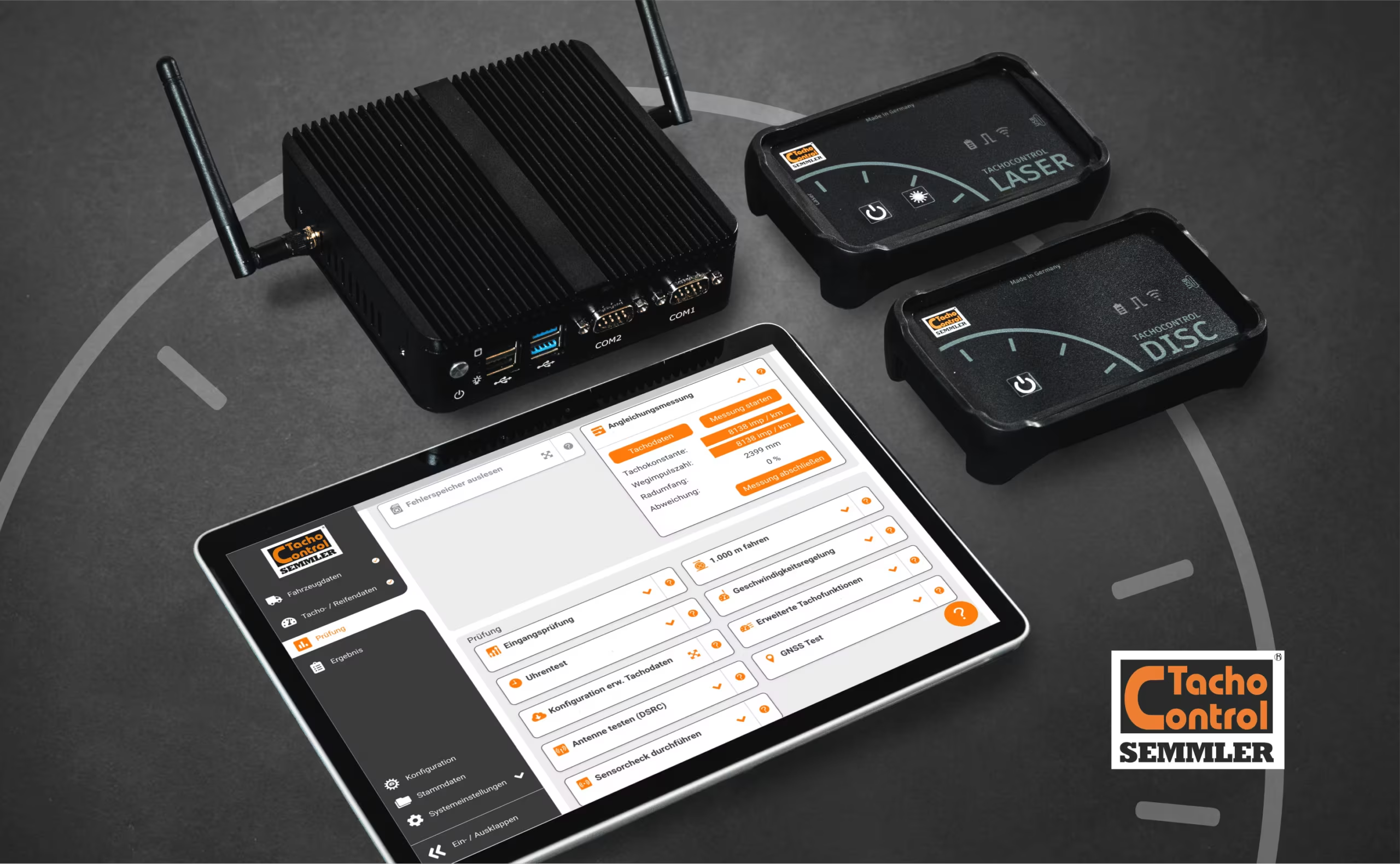
The biggest hurdle for many independent workshops when entering the tachograph service market is not the expertise, but the investment in measurement technology. This is precisely where the Pay-per-use model from TachoControl Data. Garages use the high-precision measurement technology as required and pay according to actual usage - without a high initial investment and without tying up capital for equipment that is not yet fully utilised in the start-up phase. The background is also a cloud system that records usage and handles billing transparently.
The retrofitting requirement applies to the Sprinter class from the cut-off date of 1 July 2026. Pay-per-use therefore makes it a cost-effective option even if utilisation levels level off after the initial surge. The terms and conditions can be clarified directly with TachoControl Data, as the model is specifically tailored to workshop use.

Specifically, this means for the workshop set-up: First, the workshop and TachoControl Data jointly analyse the current and future requirements. The measurement technology solution is then customised to the workshop's own order mix and billing is transparent and based on actual usage. This shifts the risk away from fixed costs. Many independent companies lack precisely this prerequisite, which is why they would otherwise not even take up the tachograph service.
Inspection every two years: fixed dates for the workshop
Under Article 23 of Regulation (EU) No 165/2014, every tachograph must be inspected at least every two years. This also applies to newly fitted tachographs in light commercial vehicles. The inspections are carried out by authorised workshops. In Germany, the regulations Section 57b of the Road Traffic Regulations (StVZO) the inspection and stipulates that the keeper is responsible for this. The deadline expires at the end of the month in which two years have elapsed since the last inspection.
The inspection covers, amongst other things, correct fitting, functionality, the fitting label, the seals and the tyre circumference. In addition, an inspection of the tachograph is required after every repair. The same applies if the effective tyre circumference changes. The workshop must retain the re-inspection report for at least two years. In Germany, inspections may only be carried out by manufacturers, workshops commissioned by them, or workshops recognised in accordance with Annex XVIIId of the StVZO.
For your workshop, this means a recurring appointment for each vehicle. Whoever carried out the retrofit will know when it is due and can contact the customer in good time. The follow-up check can be combined with a service or a tyre change during the same appointment.
Follow-up business: data service for fleet customers
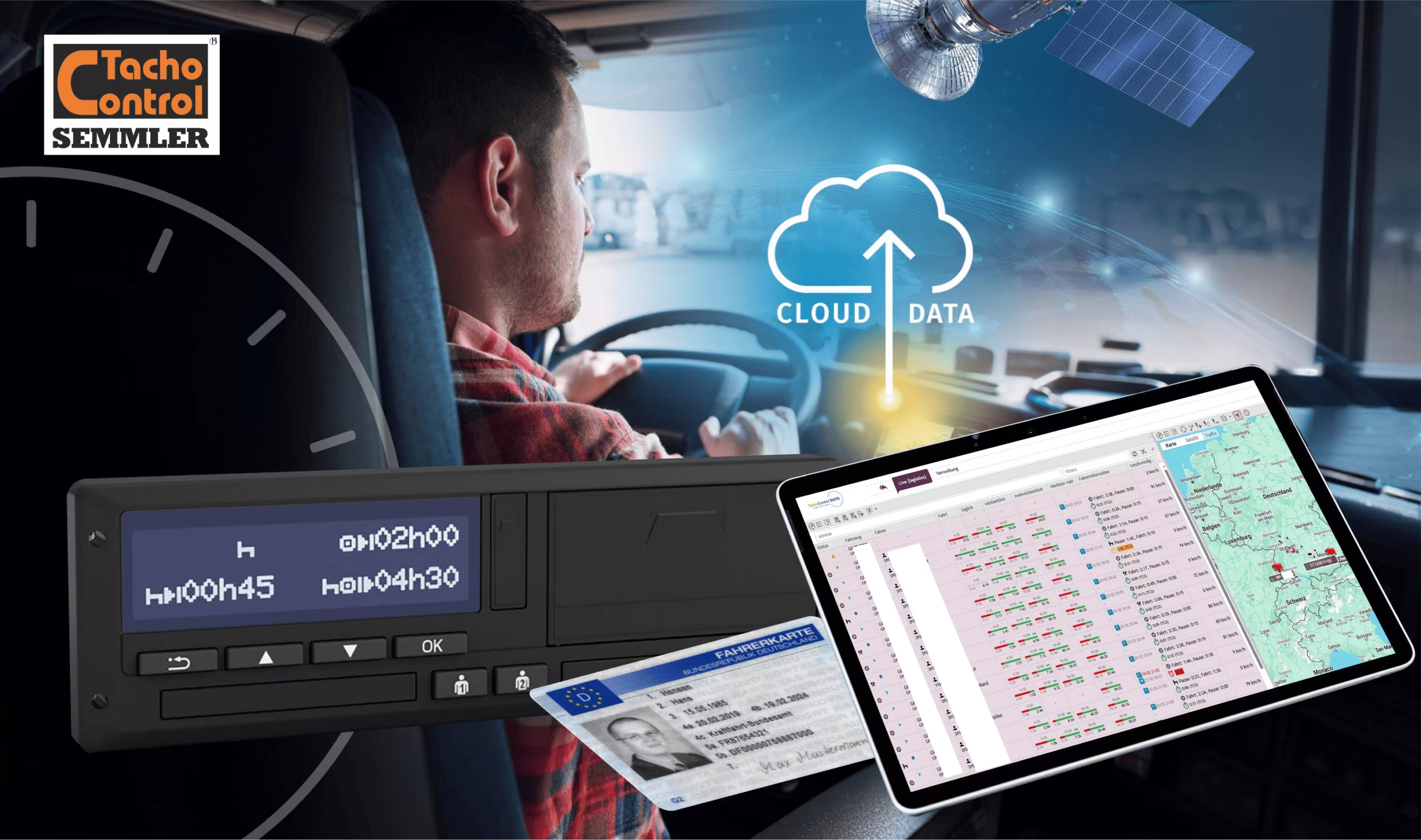
Installation is not the end of the service, but the beginning. From the cut-off date onwards, transport companies must regularly download, archive and retain tachograph data for inspection purposes. Garages can offer this as a service. Independent garages can therefore offer more than just hardware sales. TachoControl Data provides three coordinated modules for this purpose, which can be passed on to their own fleet customers as a recurring service.
- TCD Download Set - Readout and download solution for driver and vehicle data directly on the tachograph. Suitable as a workshop service for regular service appointments.
- TCD-Download web++ - Automatic archiving in accordance with legal requirements, without manual data transfers. Makes the workshop the customer's compliance anchor.
- TCD-Download web+++ - Telematics integration with real-time localisation and prepared reports. More in-depth service package for customers who want to manage their fleet digitally.
For the workshop, this bridges the gap between a one-off job and an ongoing service relationship. After all, anyone who sells data management as part of the installation will have the customer in their system for the next calibration, the next download cycle and the regular inspection at least every two years. Furthermore, those who integrate the data service seamlessly into their own order processing benefit from predictable repeat appointments. The article ‘Order Planning in the Commercial Vehicle Workshop’, recommended as further reading, therefore demonstrates how such service packages can be integrated into workshop management.
- Check tachograph authorisation in the company - inspect inventory, update recognition with the responsible body
- Clarify measurement technology setup - weigh up purchase versus pay-per-use via TachoControl Data
- Plan personnel qualification: who in the team installs, who calibrates, who does the customer handover
- Trigger inclusion in the Global Tachograph Network - visibility in the station finder before the enquiry peak
- Targeting existing customers with Sprinter fleets and scheduling appointments in waves
- Put together a service package: offer installation + calibration + handover + data management as a bundle
- Structure follow-up business: Schedule TCD download set / web++ / web+++ as a recurring item
Note from our industry partner: The products mentioned in this article (Smart V2 retrofit kit, DTCO 1381 SMART Gen.2, TCD Download Set / web++ / web+++) mentioned in this article, the Global Tachograph Network and the pay-per-use model for measurement technology are solutions provided by TachoControl Data. TachoControl Data also offers these under its own professional responsibility. Alltrucks, on the other hand, provides editorial guidance on the regulatory requirements and the available components for the independent commercial vehicle workshops within the network. In Germany, supervision is the responsibility of the authorities designated by the federal states and, in addition, the Federal Office for Logistics and Mobility (BALM).