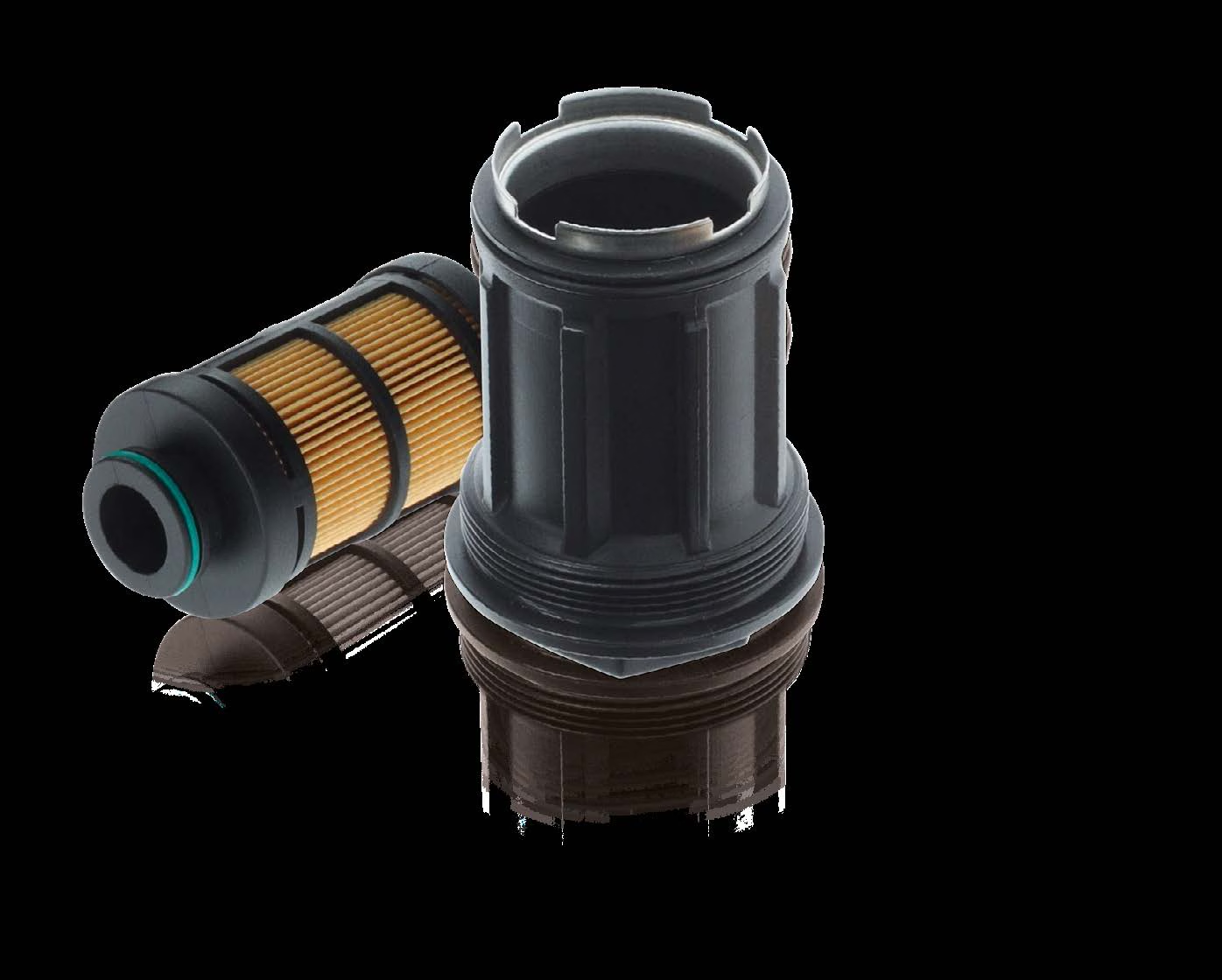
The Bosch Denoxtronic filter programme was previously tailored to Bosch's own injection systems. With two new part numbers, Bosch is now expanding its portfolio to include urea filters for Cummins Hilite systems. These are AdBlue dosing modules from a third-party supplier that are used in the Mercedes-Benz Actros and in lorries from DAF and Scania are installed. For independent garages and commercial vehicle wholesalers, this is above all a logistical simplification. Previously, they had to switch to different suppliers for different vehicle fleets. Instead, the SCR maintenance now also for these external systems via the usual Bosch supply sources.
Background: As a co-founder of Alltrucks (together with Knorr-Bremse), Bosch is closely interlinked with the workshop network. Programme expansions in the Bosch Aftermarket therefore have a comparatively rapid impact on the day-to-day operations of partner workshops. Anyone working in parallel on the Truck diagnostics or access to OEM systems also knows the logic: fewer interfaces, more reach per tool and per product range.
Key point for the workshop: The two new part numbers F 026 405 001 (cellulose-based filter medium, older generation) and F 026 405 002 (synthetic filter medium, more recent generation) cover two generations of the Cummins Hilite dosing module. However, the correct part number is not determined by the truck brand, but by the VIN and the specific Hilite generation. This also applies to the Actros, as both generations are available on the market, depending on the year of manufacture.
What are Cummins Hilite systems?
Cummins is an established name as a component manufacturer in the commercial vehicle sector. The brand is primarily known for combustion engines, but also for exhaust gas aftertreatment modules. The Hilite systems are the dosing solution for AdBlue in this portfolio. In the SCR line, they take on the task of introducing the aqueous urea solution („urea“, technical term for AdBlue) into the hot exhaust gas flow in fine doses. This converts the nitrogen oxides into nitrogen and water in accordance with the exhaust gas standard.
These Hilite modules are not only installed in Cummins' own applications, but also in trucks from several manufacturers that rely on the Cummins system instead of a Bosch Denoxtronic. In the heavy-duty segment, this is particularly evident in three brands:
- Mercedes-Benz Actros - Both Cummins-Hilite generations on the market; older with cellulose-based, more recent with synthetic filter medium
- DAF - More recent Cummins-Hilite generation with synthetic filter medium
- Scania - More recent Cummins-Hilite generation with synthetic filter medium
What this means for acceptance: The brand alone is not sufficient to determine the part number. Depending on the year of manufacture and Hilite generation, either F 026 405 001 or F 026 405 002 is the correct choice for Actros. For DAF and Scania, on the other hand, the current generation points to F 026 405 002, so the cleanest method is to compare the VIN using the Bosch catalogue, especially for mixed fleets that are managed across several brands anyway.
For the workshop, this means in practice: in the event of an AdBlue-related service case, the vehicle identification via VIN and system status determines which filter and therefore which part number is required. This applies both to a planned filter change routine and to a subsequent fault resulting from clogged nozzles. Confusion between the two generations can also be avoided if this point is clearly set in the acceptance process.
What is changing for the Bosch filter programme
Until now, the Denoxtronic filter programme was consistently designed for Bosch's own injection system. With the current expansion to include solutions for third-party systems, Bosch is now opening up the programme at a point where independent workshops and wholesalers previously had gaps in their product range. These were previously covered by third-party suppliers, whose quality and delivery level was not always comparable with the Bosch standard.
One part number per generation
The two new Bosch part numbers:
| Criterion | F 026 405 001 | F 026 405 002 |
|---|---|---|
| System generation | older Cummins Hilite generation | more recent Cummins Hilite generation |
| Filter medium | cellulose-based | Synthetic |
| Vehicle application | Mercedes-Benz Actros (older Hilite generation) | Mercedes-Benz Actros, DAF, Scania (more recent Hilite generation) |
| Service set available | — | yes, incl. maintenance grease for installation |
| Tightening torque of filter element | according to manufacturer's specifications | 80 Nm (according to Bosch service set) |
| Identification | via VIN, system status, Bosch catalogue | via VIN, system status, Bosch catalogue |
| Availability | as of now | as of now |
The message to the parts planning department: until now, a truck mix with Actros, DAF and Scania has split the range between several suppliers. Instead, the AdBlue filter requirements can now be bundled in the Bosch standard route. This also has less to do with marketing than with the reality of warehousing and procurement: fewer suppliers, fewer order cycles, fewer interfaces for complaints.
Material and filter performance: why the filter counts
AdBlue is an aqueous urea solution. It is chemically aggressive towards many standard materials and sensitive to impurities. If particles migrate into the dosing module, this creates a chain of subsequent problems that can be easily recognised in everyday workshop operations:
- Blockages in nozzles and dosing valve - the dosing accuracy suffers, in extreme cases the injection fails
- Sub-optimal AdBlue dosing - either too little (NOx conversion decreases) or too much (consumption increases)
- Increased AdBlue consumption - an economic position that sees the fleet directly in the TCO
- Consequential damage in the SCR system - to costly replacement work on components that are significantly more expensive than a filter
The filter materials of the new Bosch part numbers are specially designed for resistance to AdBlue and are intended to maintain a consistently high filter performance over the entire service life. The switch to a synthetic filter medium in the latest generation also follows the same logic that is also evident in other filter classes: higher resistance, more uniform pore structure, longer service life.
„Without effective filtration, particles can cause blockages, sub-optimal AdBlue dosing, increased AdBlue consumption or even costly performance losses.“- Bosch Mobility Aftermarket, press release February 2026
Replacing the urea filter in the workshop: Service set
For the part number with synthetic filter medium (F 026 405 002), Bosch offers a service set. This bundles the parts required for the replacement, including maintenance grease. This reduces the preparation at the point of acceptance to a single ordering process. The actual replacement then follows three short steps:
Remove the maintenance grease from the service set
The service set contains the maintenance grease required for installation. This eliminates the need to purchase separate lubricants, a detail that saves downtime during the acceptance process.
Align the filter element and grease the seals
Align the filter element towards the housing. Then grease the outer and inner seal with the maintenance grease. A properly greased seal prevents friction and consequential damage when tightening.
Tighten filter element with 80 Nm
Screw the filter element into the housing with the torque of 80 Nm specified by Bosch. This completes the mechanical part of the replacement. This is followed by the usual leak and function test of the dosing module.
Bosch refers to regular replacement of the urea filter in accordance with the manufacturer's instructions. A fixed kilometre or time specification therefore applies per vehicle. It should therefore be stored in the workshop management system for each manufacturer and not listed as a general interval.
Practice in the workshop: Acceptance, identification, change
For everyday workshop operations, the programme expansion is not a reason for a new process, but rather for a sharpening of the existing one. Anyone accepting Actros, DAF or Scania lorries with AdBlue problems now has a Bosch answer on the shelf with Cummins Hilite systems. A short standard sequence also helps to ensure a clean fit in the order.
Vehicle identification via VIN
First read out the VIN and compare it with the manufacturer model and system generation. For Actros, the Cummins-Hilite generation determines whether the cellulose-based F 026 405 001 or the synthetic F 026 405 002 fits. With DAF and Scania, however, the current generation points to F 026 405 002. Confirm this anyway using the Bosch catalogue plus VIN instead of making a blanket order by brand.
Clarify diagnostic findings
First clarify whether it is a planned service or a subsequent fault. Using ESI[tronic] 2.0 or the KTS Truck multi-brand diagnostics, error patterns relating to dosing, pressures and tank sensors can be precisely localised before you intervene mechanically.
Derive and plan part numbers
Then use the identified generation to select the correct one of the two new Bosch part numbers: F 026 405 001 (cellulose-based) or F 026 405 002 (synthetic, incl. service set option). If you have a mixed fleet, it is also worth keeping a small stock of both part numbers in order to avoid downtime.
Filter change and function test
Replace according to the manufacturer's instructions, for F 026 405 002 using the Bosch service set including maintenance grease. Align the filter element with the housing, grease the outer and inner seal and tighten to 80 Nm. Then check the dosing module for leaks and functionality. After the service, randomly run the AdBlue consumption values in the telematics or diagnostic log, as this is the easiest way to check the effectiveness.
Customer communication
The information „SCR maintenance now also in Bosch quality for Cummins Hilite“ is a concrete added service value, especially for fleet customers with a mixed brand portfolio. This makes the difference between a routine item and an actively communicated service.
Store the assignment of Actros generation to filter medium in your workshop management system as a mandatory field when creating an order. This will prevent the wrong filter being fitted during the AdBlue service. This is the most common avoidable source of errors when changing generations in the range.
What the programme expansion means for Alltrucks partner workshops
In the Alltrucks portfolio, 14 commercial vehicle manufacturers are represented in the diagnostic and service scope. Mercedes-Benz, DAF and Scania are among the brands with a high workshop frequency. This is precisely where the Bosch expansion comes in. As a result, the Multi-brand workshop in the network a piece of the external range into the central Bosch procurement track.
- Check current stock for AdBlue filter Cummins Hilite against stock and supplier mix.
- Enter both new Bosch part numbers into the workshop management system - with clear generation assignment.
- Add the item „Check Hilite system status“ to the acceptance checklist for Actros, DAF and Scania.
- Actively communicate added service value to fleet customers - this is a concrete argument, especially for mixed fleets.
- If you have any technical queries, use the Bosch sources and the ESI[tronic] 2.0 background as a starting point.
The expansion is a systematic addition to the product range that brings the Bosch Aftermarket programme closer to the real brand mix in multi-brand workshops. For workshops that already rely on Bosch standards in Diagnostics and spare parts are now available, closing a previously unfilled gap in the SCR range.