Lubricants are among the operating materials that are easily overlooked in the workshop - until they become a problem. For a commercial vehicle workshop, however, the handling of engine oils, transmission oils and speciality lubricants is a direct driver of results. Every unnecessary oil change costs productive time, every late intervention costs components. The ACEA classification provides the technical guidelines for this. At the same time, the market is developing in the direction of resource-saving formulations, supported by strict regulations relating to CO2 and waste oil utilisation.
This article shows how TotalEnergies works with the Rubia EV3R range and the oil analysis service LubAnac brings two current variables into the commercial vehicle workshop. Both topics are interlinked. An engine oil based on re-refined base oils does not alter the workshop process in any way. A structured oil analysis, on the other hand, only realises its full potential when used in conjunction with a lubricant that maintains its performance cycle consistently. Anyone working in parallel on a structured maintenance plan and preventive maintenance is therefore adjusting three key factors simultaneously. Alltrucks also discussed maintenance costs and lubricants with TotalEnergies at the Transport Day 2026 in Italy. The partnership with TotalEnergies Lubricants has seen Alltrucks 2026 extended by a further three years.
The key message from the lubricant market for oil analysis and lubricants in commercial vehicles: performance and sustainability are no longer opposites. Re-refined base oils fulfil the same OEM approvals as conventional base oils. At the same time, they reduce the resources required in the product life cycle. For the workshop, this means no compromises in engine protection and an additional argument in discussions with customers.
Why lubricant strategy counts in the commercial vehicle workshop
Modern commercial vehicle engines work with tightly toleranced components, high combustion chamber pressures and strict emission specifications. The lubricant does much more than „just“ reduce friction. It protects bearings, valve trains and turbochargers, removes heat, keeps soot and combustion residues in suspension, neutralises acids and maintains seal elasticity. Each of these performance profiles is closely linked to the additive chemistry of the oil. It is also crucial that the oil does not lose its specification during the change interval.
The direct economic effect
A consistently managed lubricant portfolio reduces the number of variants in the workshop. This simplifies purchasing and warehouse logistics and reduces the risk of mix-ups in release allocations. At the same time, an oil that keeps its cycle clean has a direct impact on component service life. Those who minimise their throughput times by Structured order preparation optimised, often finds the next quiet efficiency gain in lubricant handling.
The sustainability factor
Waste oil utilisation is strictly regulated in Europe. Increasingly, this also applies to the origin of base oils. Re-refined base oils are an interesting component in this context, both from a regulatory and economic perspective. This is because they reduce the need for primary raw materials and strengthen the circular economy without compromising engine protection. For fleet customers with their own ESG targets, the choice of lubricant has therefore become a relevant negotiating point.
„Rubia EV3R stands for a solution that harmonises environment, performance and economy.“- TotalEnergies Lubricants, Rubia EV3R programme
Rubia EV3R: Re-Refined Base Oils and the 3R principle
Rubia EV3R is based on a consistent eco-design concept. It is based on the careful selection of high-quality Re-Refined Base Oils (RRBO). These are processed base oils that are recycled from professionally collected waste oils in a multi-stage process to achieve as-new quality. The performance also corresponds to that of conventional formulations: proven oxidation stability, proven engine cleaning, resilient wear protection and stable corrosion control.
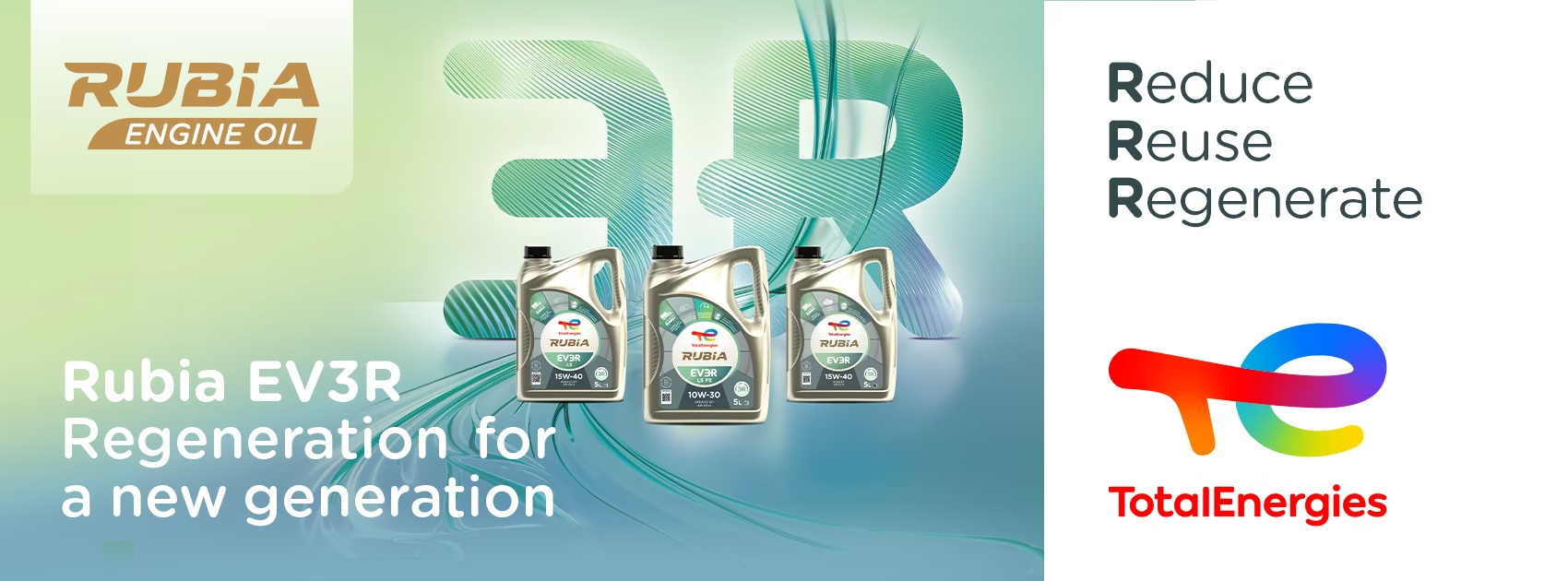
The 3R concept
Behind the name EV3R is a precise crash barrier. Reduce addresses the minimisation of the use of primary raw materials and the avoidance of waste in the product life cycle. Reuse stands for the second utilisation round of used oils, which are reintegrated in a controlled recycling process. Regenerate finally describes the technical core: the recovery of high-quality base oils using modern refining technologies that ensure performance at the level of new oil.
Ecodesign right down to the packaging
Rubia EV3R's eco-design concept extends beyond the product itself. Lighter, recyclable packaging also reduces material requirements and transport emissions. This does not result in any process changes for the workshop. However, it gains a consistent sustainability argument throughout that is robust in audit discussions with fleet customers.
Actively communicate the ecodesign properties of your lubricants in service reports and annual analyses. Fleet customers with ESG reporting obligations will gratefully accept this information. Because it relieves their own Scope 3 balance sheet without additional effort on your part.
OEM approvals and technical compatibility
The Rubia range fulfils more than 200 OEM approvals across its entire spectrum. This number makes the decisive difference for mixed fleets. An oil shelf that covers the common European manufacturer specifications in just a few containers reduces storage and mix-up risks and simplifies documentation in the workshop management system. Rubia EV3R is also customised to the latest engine technologies - including modern Emission aftertreatment systems and the associated requirements for ash behaviour and sulphur content.
LubAnac: structured oil analysis as a preventive mechanism
The second pillar is LubAnac - an oil analysis service that creates a detailed picture of the situation from every sample. The strength lies in the preventive approach. Wear metals, fuel and water ingress, oxidation, soot load and residual additives are determined in the laboratory and analysed in a structured report. This provides fleet managers and workshop managers with a factual basis for planning maintenance appointments based on data - not on instinct.

What a good oil analysis delivers
The interpretation of the analysis parameters is often more valuable than the individual values themselves. Traces of iron, copper, aluminium and chrome indicate different sources of wear - from the bearing to the camshaft to the turbocharger. Fuel ingress can also reveal injection problems at an early stage, while cooling water ingress indicates sealing problems or cracks. A laboratory report that translates these values into a traffic light system and links them to recommendations for action therefore becomes a workshop tool - not a PDF in your e-mail inbox.
Sampling at every maintenance
Standardised sampling set, clear labelling with vehicle ID and mileage, then dispatch to the laboratory. This takes just a few minutes per vehicle and can therefore be integrated into any existing maintenance process.
Laboratory analysis according to standard procedures
Firstly, wear metals, contamination, oxidation level, additive level and viscosity are determined. The results are then entered into an intuitive digital portal - transparent and comprehensible for the workshop and fleet customer.
Report with recommendations for action
The report derives a classification from the measured values: Oil can still be used, change oil, or further investigation recommended. Critical parameters are clearly marked and trend lines for each vehicle are also visible at a glance.
Integration into the workshop management system
The reports are stored in the vehicle data record and recommendations for action are also incorporated into the service plan. Over time, this creates a reliable history that is equally valuable for preventive maintenance and warranty discussions.
State-based intervals where it makes sense
With suitable application profiles, oil change intervals can be optimised on the basis of the analysis results - always within the scope of OEM approvals. This reduces unnecessary changes and gets the full performance out of the oil.
The effect on everyday workshop life
LubAnac shifts the maintenance decision from reactive to predictable. Early indications of wear conditions allow targeted interventions before a fault becomes visible as a breakdown. At the same time, the frequency of unnecessary oil changes is reduced with well-preserved oils - with a direct effect on material and disposal costs as well as productive workshop time. For fleet customers, oil analyses and lubricants in commercial vehicles thus become part of the Total cost of ownership discussion, not just a shopping side issue.
"LubAnac increases the reliability of vehicles, reduces unplanned downtime and supports needs-based maintenance planning - for sustainably lower operating costs."- TotalEnergies Lubricants, LubAnac programme
Practical integration in the workshop and fleet
The introduction of a structured lubricant strategy is not a major project effort. Rather, it is a series of comprehensible decisions that reinforce each other. It makes sense to start with the oil portfolio: analysing the product range, comparing it with the approvals of the vehicles being serviced, switching to a coordinated Rubia range with broad OEM coverage. This is followed by establishing the oil analysis as an integral part of the maintenance routine - initially in pilot fleets, then rolled out on a broad basis.
- Check your current oil shelf: How many containers, how many releases, what consolidation potential?
- Identify fleet customers with an ESG reporting obligation - Re-Refined Base Oils are an active sales factor there.
- Set up a sampling kit and process for oil samples at each regular maintenance.
- Determine who reads the lab reports and transfers them to the workshop management system - accountability creates quality.
- Discuss condition-based oil change intervals with your fleet customers - always within the scope of OEM approvals.
- Use the eco-design arguments of Rubia EV3R actively in discussions with customers and in annual reports.
Those who also work on the maintenance strategy and digital service histories are thus building a stable foundation for condition-based maintenance - and therefore for the cost-effective support of large mixed fleets in Europe.