The brake is what decides what the free Lorry workshop can seriously promise the fleet customer. Braking distance, noise behaviour, service life of disc and pad, consumption, particulate matter: all this depends on whether the pad, disc, caliper and axle are matched to each other as a system. If you install a less expensive pad whose friction coefficient curve or heat input deviates from the design, this shifts the behaviour of the brake. This sometimes happens visibly, often only over weeks and months.
Knorr-Bremse - as co-founder of Alltrucks in a joint venture with Bosch - develops brake linings in OE quality for precisely this logic. A pad fits the brake because it was developed according to the specifications with which the brake is approved at the factory. This article first explains what is behind the term. It also shows which tests go beyond the European minimum standards. Finally, it clarifies why NVH tests, residual grinding torque and friction mass optimisation are more than just technical catalogue lyricism for the independent commercial vehicle workshop.
OE quality means that the brake pad is developed and approved to the same specifications as for series production. At Knorr-Bremse, tests are also carried out that go beyond the European standards. These include, in particular, the NVH test. The result is therefore a pad whose behaviour in the entire braking system is comprehensible: safety, reliability, durability and low follow-up costs.
What OE quality really means for brake pads
OE - Original Equipment - does not describe the sticker, but the development and release path. A pad in OE quality is developed against the specifications with which the brake is approved for series production. These include friction coefficient curve over temperature, noise behaviour, wear behaviour, heat input into the disc and bearing as well as compatibility with the caliper. These specifications are not public, but are the property of the brake manufacturer. At Knorr-Bremse, they therefore flow directly into the development of the pads for the aftermarket.
More than the European minimum standard
ECE R90 is the European minimum standard for brake pads. It defines the minimum requirements, not the optimum. Knorr-Bremse therefore tests its brake pads in three additional dimensions: vibration, wear and performance. In particular, this includes the noise-vibration-harshness test, which evaluates the acoustic behaviour and vibrations across the entire braking system.
System instead of component
The crucial point: With OE quality, it is not the pad that is tested in isolation, but the system. The manufacturer looks at the pad, disc, caliper and axle together. It is precisely this view that gives a pad its stable, predictable behaviour in the field. This is why it ultimately makes the difference in the independent workshop between a job that is completed cleanly and one that comes back three weeks later with a squeaking noise or uneven wear.

NVH test: what it tests and why it is visible in the workshop
NVH stands for Noise, Vibration, Harshness - Noise, vibration and sensation of harshness. The NVH test evaluates the acoustic and vibration impact of a brake pad in combination with the brake disc, caliper and axle. High-frequency squealing noises, low-frequency humming sounds and vibration excitations that are transmitted into the cab via the chassis are also tested. This is therefore relevant for the driver's comfort and therefore also for the complaint rate in the workshop.
Beyond the standard test
Standard vibration and wear tests cover a large part of the flooring behaviour, but not all of it. The NVH test, on the other hand, closes a gap that often leads to complaints in practice: the noise behaviour under realistic load cases, in different temperature and humidity ranges. Knorr-Bremse therefore uses the NVH test as a supplement to rule out noise anomalies even before series production is released. This means that the problem is not only noticed when the workshop receives the complaint on the phone.
| Test dimension | European minimum standard (ECE R90) | Knorr-Bremse OE quality |
|---|---|---|
| Friction coefficient & braking power | Minimum requirement fulfilled | Optimised over the entire temperature window |
| Wear behaviour | Standard wear test | Low-wear friction material, matched to disc |
| Residual grinding torque | not specified | minimised throughout |
| NVH test (noise & vibration) | not included | Systematically tested |
| Heat input into disc & bearing | not specified | actively limited |
| System tuning pad & disc | not required | Fully integrated |
If a vehicle comes back with a squealing noise, it is worth looking at more than just the thickness of the brake disc. This is because noises are often caused by the interaction of the pad, disc and caliper and are therefore an indication of poorly tuned components.
Residual drag torque: why the brake is never fully released
Even if the driver takes his foot off the brake pedal, there is still minimal contact between the pad and the disc - the Residual grinding torque. It can never be brought to zero completely, but it can be minimised by design. High residual grinding torques generate heat in the disc, accelerate wear on the lining and disc and also put a strain on the wheel bearing. Over the service life of a lorry, these effects therefore add up to a measurable increase in consumption and shorter service life.
Knorr-Bremse brake pads, on the other hand, are matched to the entire brake system and grind less on the disc compared to alternative qualities. This has two consequences that are directly visible in the workshop. Firstly, the brake disc and therefore the wheel bearing are heated up less. In addition, the pad itself lasts longer.
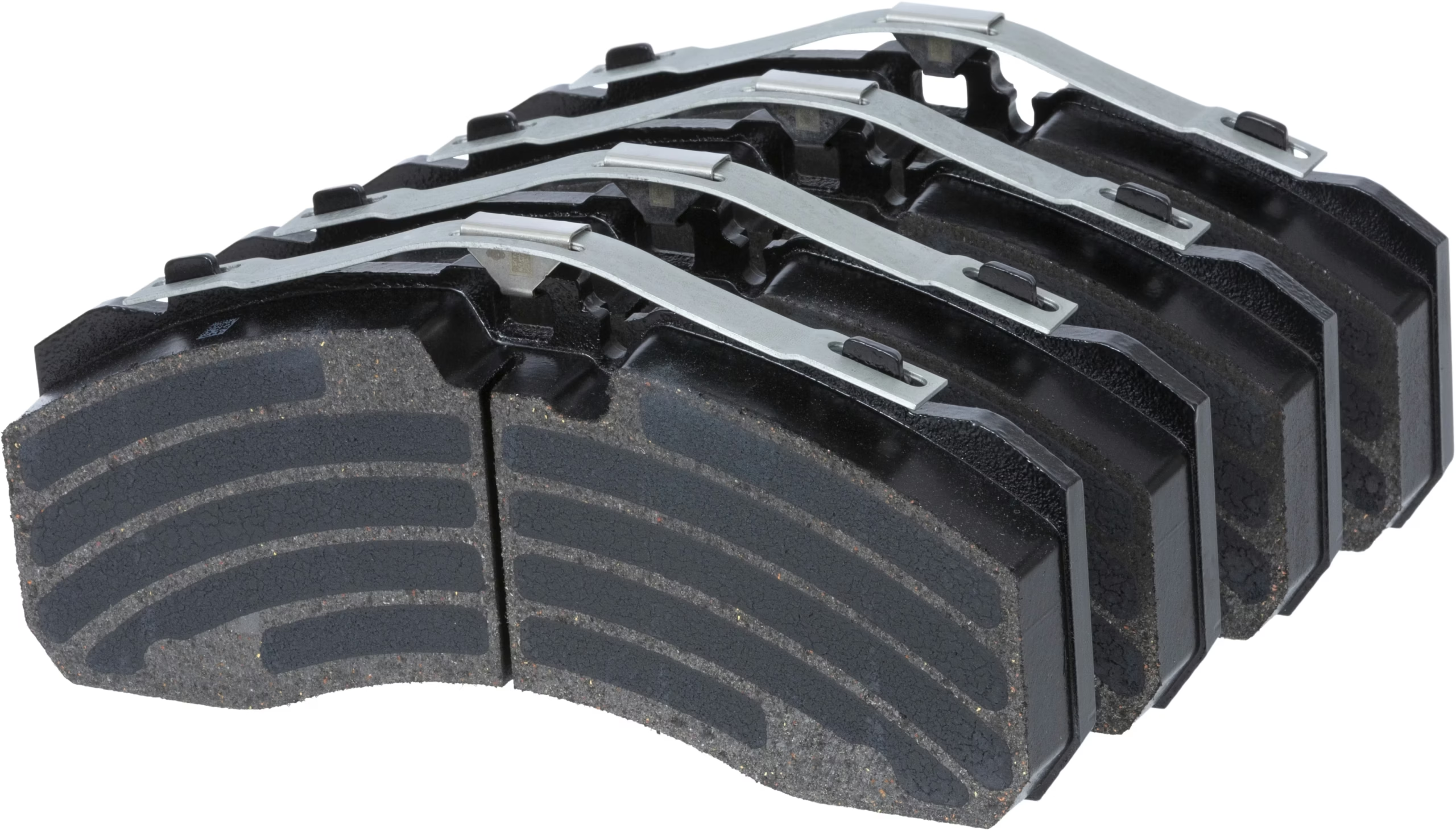
APR system: the active provision
Knorr-Bremse also offers brake pads with APR system on. A spring system actively disengages the pad and disc from each other after each braking application, i.e. decouples them. The effects are therefore visible in practice:
Reduced residual grinding torques
The active resetting of the brake pads significantly reduces unwanted friction. As a result, the disc runs freely and the brake pad is only engaged when the brakes are applied.
Lower fuel consumption and CO2 emissions
Less friction when idling means fewer drag losses. This results in a measurable effect on fuel consumption over the mileage of a lorry.
Longer service life
Linings with the APR system wear more slowly and therefore remain in use for longer. This also extends the maintenance interval and relieves the Workshop capacity utilisation.
Less particulate matter emissions
Less friction outside the braking phase also means less brake wear. This is therefore a contribution to the reduction of particulate matter, which is increasingly subject to documentation in urban delivery fleets.
„Compared to alternative qualities, pads in original equipment quality grind on the disc to a lesser extent because they are matched to the entire brake system. This protects the disc, bearings and fuel consumption.“- From the Knorr-Bremse TruckServices press release
Friction mass optimisation: maximum performance with minimised heat input
The Friction material - i.e. the mixture of friction material, binders and functional additives - is the core of every brake pad. It defines the friction coefficient curve via temperature, wear behaviour, noise susceptibility and also the heat input into the disc. At Knorr-Bremse, the friction material is therefore optimised for three simultaneous goals: maximum performance, minimised wear via the lowest residual grinding torque and reduced heat input, which protects the wheel bearing.
These three objectives are usually in conflict. More power typically means more heat. More wear means longer service life, but at the expense of performance. The design across the entire braking system instead of on the isolated pad, on the other hand, is the lever that defuses this conflict. This is precisely the difference between a pad that fulfils the ECE R90 minimum standard and an OE-quality pad.
How the independent lorry workshop benefits
The technical level is one aspect. The other is the workshop-side consequence: what does OE quality mean for the inspection, the Lead time and the complaint rate?
Predictable behaviour in the field
OE-quality brake pads behave in the field in the same way as the vehicle manufacturer intended for series production. This means fewer surprises at the next inspection. The pad thickness is within the expected range, the disc shows the expected scoring and wear characteristics and the noise behaviour is also inconspicuous.
Fewer complaints, less rework
Squealing brakes, uneven pad wear, premature disc wear: these are the typical reasons for complaints after a pad change. If, on the other hand, you work with a pad that is NVH-tested and whose friction mass is matched to the disc, you have fewer calls and fewer goodwill appointments. In a workshop with a shortage of labour, this is Multi-brand capacity a direct economic effect.
Clear arguments in favour of the fleet customer
A fleet planner who calculates the total cost of ownership does not ask for the list price of the disc. Instead, he asks about service life, consumption and follow-up costs for the disc and bearing. Original equipment quality is therefore the argument that carries weight in every order discussion.
- Think about the system when replacing the brake pad: evaluate the pad, disc, caliper and axle together - do not replace the pad in isolation.
- Document complaints with noise behaviour: Which type of brake pad, which disc, which axle load - over time, a picture emerges of which combinations are conspicuous in your own fleet.
- Fleet customers argue in favour of OE quality: Service life, consumption and follow-up costs on the disc and bearing are the key figures that carry the conversation - not the list price per pad set.
As a co-founder of Alltrucks (in a joint venture with Bosch), Knorr-Bremse is also present in the workshop service. Tips and tricks, technical content and training topics relating to brakes are therefore available to Alltrucks partners in the Alltrucks Partner Portal. Those who also work on the inspection checklist in parallel combine both levers.
