Compliance in the fleet is not a bureaucratic end in itself - it is risk management. Those who ignore legal obligations risk not only fines, but also personal liability of the management, insurance exclusions and loss of reputation in the event of damage. Failure to check a driver's licence after a serious accident can result in criminal prosecution under national criminal traffic law (driving without a licence). The regulatory guidelines are set by the competent national authorities for freight transport and mobility. Today, compliance in the vehicle fleet requires the parallel fulfilment of the EU Regulation 561/2006 (driving and rest times), the EU Regulation 165/2014 (digital tachograph), the ISO 39001 (RTS Management), the EU Directive 2014/45 (periodic technical inspection) and the national professional driver qualification regulations (implemented from EU Directive 2003/59).
This article provides an overview of the most important compliance obligations in the commercial vehicle fleet, their legal basis and typical pitfalls. It is not a substitute for legal advice, but rather a structured guide for your compliance audit. More in-depth information on the role of the fleet manager in the article Tasks in fleet management. Practical figures are provided by national freight transport associations.
Fleet compliance is the adherence to all legal and regulatory requirements for owners and fleet managers when operating commercial vehicle fleets. It includes owner liability, driving licence checks, health and safety inspections, driving and rest periods, load securing and data protection. Violations can result in significant official penalties per case.
What does owner liability in the vehicle fleet actually mean?
In most European legal systems, the keeper of a vehicle is the central addressee of all vehicle-related obligations. The keeper is not necessarily the owner - in the case of leased vehicles, for example, the lessee is usually the keeper. The keeper is the person who uses the vehicle for their own account and exercises the power of disposal.
Dozens of duties arise from this holder position: ensuring technical road safety, complying with statutory inspections, ensuring insurance, checking the suitability of drivers, monitoring driving times, taking responsibility for securing loads, organising health and safety inspections. The most important realisation: these duties can be delegated to the fleet manager - but the responsibility under liability law remains with the owner and therefore with the management.
Important for managing directors: Delegating operational tasks to a fleet manager does not release you from your liability. You must monitor the fulfilment of tasks (duty to select, duty to issue instructions, duty to monitor). A delegation must be documented in writing and the delegatee must be qualified and equipped with the necessary competences. If you insist on this, the compliance reports must land on your desk regularly.
When is the health and safety inspection of vehicles mandatory?
| Key figure | Formula | Target value |
|---|---|---|
| TCO per kilometre | Total costs / kilometres driven | Trend: minus 3 to 5 per cent per year |
| Availability rate | Operating days / calendar days | over 92 per cent |
| Loss ratio | Damage / vehicles per year | below 0.8 |
| Maintenance rate | Maintenance costs / total costs | 12 to 18 per cent |
| Fuel efficiency | litres per 100 kilometres | minus 5 per cent per year |
| Compliance rate | Completed / Compulsory tests | 100 per cent |
Health and safety inspection as an annual obligation: The periodic inspection of commercial work equipment (implemented from EU Directive 2009/104, transposed into national regulations) is mandatory for all commercially used commercial vehicles at least once a year - from heavy goods vehicles and vans to 7.5-tonne trucks and trailers. It must be carried out by an expert and documented in the inspection logbook. The compliance rate as a KPI should reach 100 per cent; every overdue inspection increases the management's liability risk.
The health and safety inspection - often referred to as the „work equipment inspection“ in national regulations - is one of the most frequently overlooked compliance obligations. It requires all commercially used vehicles to be inspected at least once a year by an expert to ensure that they are in a safe operating condition. Unlike the general inspection, this is not about road safety in the narrower sense, but about protecting employees from accidents at work with the vehicle. If you want to delve deeper, you can find more information in the article on Inspection checklist Further information.
This obligation applies to all commercial vehicles in commercial use - from heavy lorries and vans to 7.5-tonne trucks and trailers. The inspection must be carried out by an expert - usually in a qualified commercial vehicle workshop - and documented in an inspection logbook.
How do you ensure driving and rest time compliance?
EU Regulations 561/2006 and 165/2014 on driving times and rest periods apply to drivers of vehicles over 3.5 tonnes. They regulate the maximum daily and weekly driving times, the mandatory breaks and the daily and weekly rest periods. The most important key values: maximum 9 hours of driving time per day (up to 10 hours twice a week), maximum 56 hours per week, maximum 90 hours per double week, at least 11 hours of daily rest, at least 45 hours of weekly rest.
Compliance is documented via the digital tachograph in accordance with EU 165/2014. Infringements are detected during roadside checks or company audits and penalised according to nationally determined fines against drivers and companies. The individual penalties add up if several infringements are detected in one inspection - specific amounts are set out in the current national catalogue.
For the professional testing, calibration and sealing of digital tachographs, the Alltrucks network works with partners such as Semmler TachoControl together.
Practice from the Alltrucks partner network shows: A weekly tachograph evaluation helps to recognise recurring minor offences early on before they appear as a bundle of findings in an inspection. If anomalies do occur, individual driver training is part of the standard response.
How do you carry out the driving licence check in a legally compliant manner?
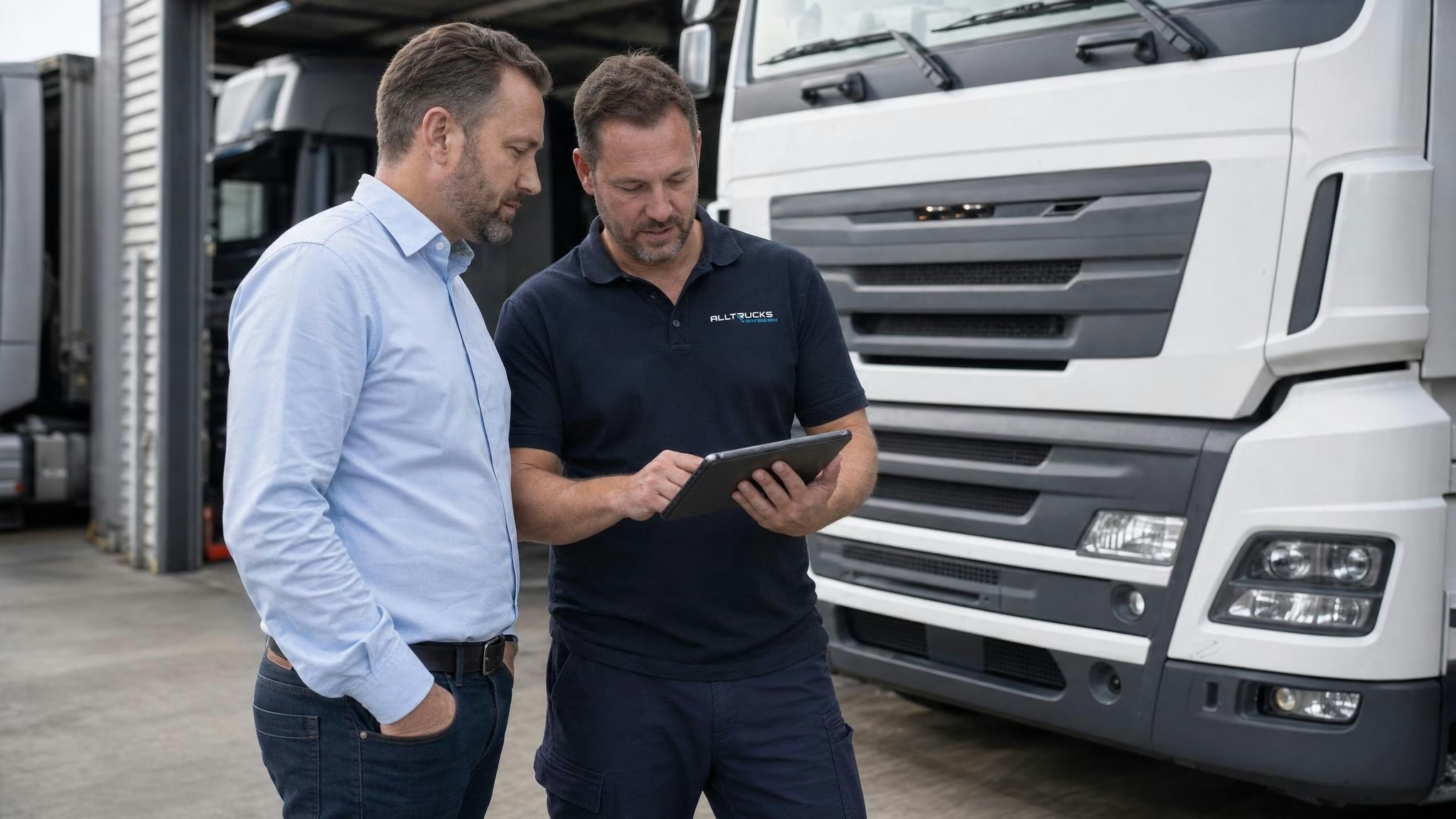
Regular driving licence checks are one of the most important compliance obligations - and also one of the most frequently neglected. The owner is obliged to check at least every six months that all drivers have a valid driving licence in the required category. In the case of professional drivers, there are also obligations for regular further training in accordance with EU Directive 2003/59 - 35 hours every 5 years.
Anyone who is negligent here risks massive consequences. If a driver without a valid driving licence causes an accident, the owner can be prosecuted under national criminal traffic law for „allowing driving without a licence“. The insurance company can refuse to pay benefits or take recourse. For the keeper, the matter becomes a threat to their existence.
Practical tip: Manual driving licence checks do not work reliably. Establish an electronic procedure (RFID chip in the driving licence, app-based check) and document every check process. Professional fleet management software automatically reminds drivers of upcoming checks and blocks vehicle use in an emergency.
How do fleets implement load securing in compliance with the law?
Load securing is an area in which the owner, vehicle driver and shipper are equally responsible. The legal basis can be found in the EU Directive 2014/47 (technical roadside inspections), in national road traffic regulations, in the standards of the EN 12195 series and in the respective national commercial law. It must be secured against slipping, rolling, falling over, falling down and inadmissible noise - and in such a way that it would also hold at 0.8 g during emergency braking.
For the fleet manager, this means providing sufficient lashing equipment, organising regular training, developing load securing plans for typical operations and carrying out spot checks. Violations of load securing are penalised with tangible sanctions for both the driver and the company - and in the event of damage, it gets really expensive.
How do you keep periodic technical monitoring, exhaust gas and safety inspections under control?
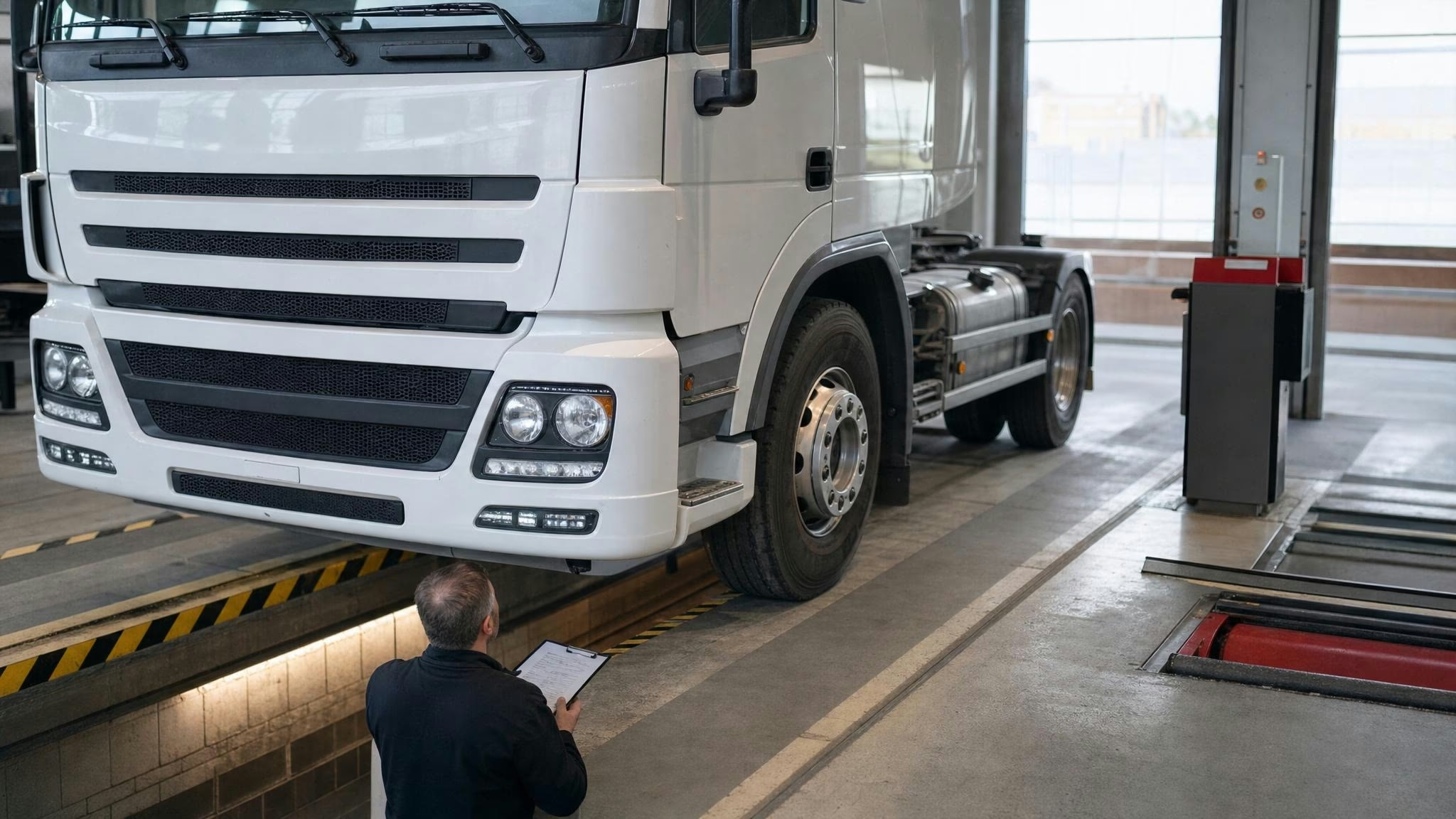
The regular mandatory vehicle inspections are the most obvious compliance obligation - and yet they are often carried out late. The most important dates at a glance (nationally implemented from EU Directive 2014/45): Main inspection annually for commercial vehicles over 3.5 tonnes, supplementary safety inspection for vehicles over 7.5 tonnes and trailers over 10 tonnes, exhaust emissions test usually together with the main inspection.
If you are late for an appointment, you risk staggered fines that increase with the length of the delay. However, an accident involving a vehicle without a valid general inspection can have much more serious consequences: Insurance cover may be restricted, the owner may be held personally liable and claims settlement becomes much more complicated.
| Compulsory | Frequency | Fine for offence | Risk of damage |
|---|---|---|---|
| Main inspection / exhaust gas | yearly | Graduated warning fine | Insurance exclusion |
| Safety check | yearly | Warning fine | Insurance exclusion |
| Occupational safety test | yearly | Health and safety procedures | Personal liability |
| Driving licence check | Half-yearly | official sanction | Criminal proceedings |
| Driving times | Ongoing | Sanction according to EU 561/2006 + national catalogue | Insurance reduction |
How do fleets fulfil data protection requirements under the GDPR?
The GDPR makes the fleet manager a data protection officer in their own right. Anyone who uses telematics, records driving licence data, evaluates fuel card usage or stores damage data is processing employees' personal data. This requires clear regulations in the company agreement, transparent information obligations and appropriate technical and organisational measures.
Telematics systems are particularly critical: they record movement data, driving style, break times and locations - all highly sensitive information. Introducing telematics without the involvement of the works council under co-determination law and without a data protection impact assessment is highly risky from a legal perspective. You should always involve a data protection officer here.
How does a compliance audit work as a self-audit?
Compliance is not a state, but a process. Once you have set everything up correctly, you are not off the hook forever - regulations change, vehicles come and go, employees change. A regular compliance audit is therefore non-negotiable. More in-depth information in the article on Fleet KPIs.
A good audit comprises three levels: formal requirements (are all inspection deadlines met, are all documents up to date?), processes (do the routines work, are there comprehensible procedures?) and spot checks (are the records correct, do they correspond to reality?). Ideally carried out externally once a year - and repeated internally in the following months.
An external view regularly uncovers gaps that are overlooked in day-to-day business - not because an audit is mandatory, but because routine makes you blind to your operations.
- Delegate keeper liability to fleet managers in writing - with specifications and reporting obligations
- Record health and safety inspection dates for all vehicles in the system and set up automated reminders
- Establish driving licence check procedure - every six months with documentation
- Systematise tachograph evaluation - weekly, with traffic light system; calibration via certified test centres such as Semmler TachoControl
- Carry out and document load securing training at least once a year
- Creating a data protection impact assessment for telematics and driving licence data
- Commission an annual external compliance audit
- Software solution that automates compliance tracking
- Clarify workshop and service connection: Alltrucks Fleet for mixed fleets - clarify suitability in dialogue with us